Gen Z is entering adult life in a money environment that feels more complicated than it did for previous generations. Many young adults are dealing with rent pressure, student loans, social media lifestyle pressure, subscriptions, buy-now-pay-later apps, online scams, side hustles, unstable early-career income, and the feeling that every financial decision is urgent.
Personal finance can feel intimidating when you are just starting. You may hear people talk about budgeting, credit scores, emergency funds, investing, debt payoff, retirement accounts, taxes, inflation, net worth, and financial freedom all at once. The truth is simpler: personal finance is the skill of making money decisions that protect your present and improve your future.
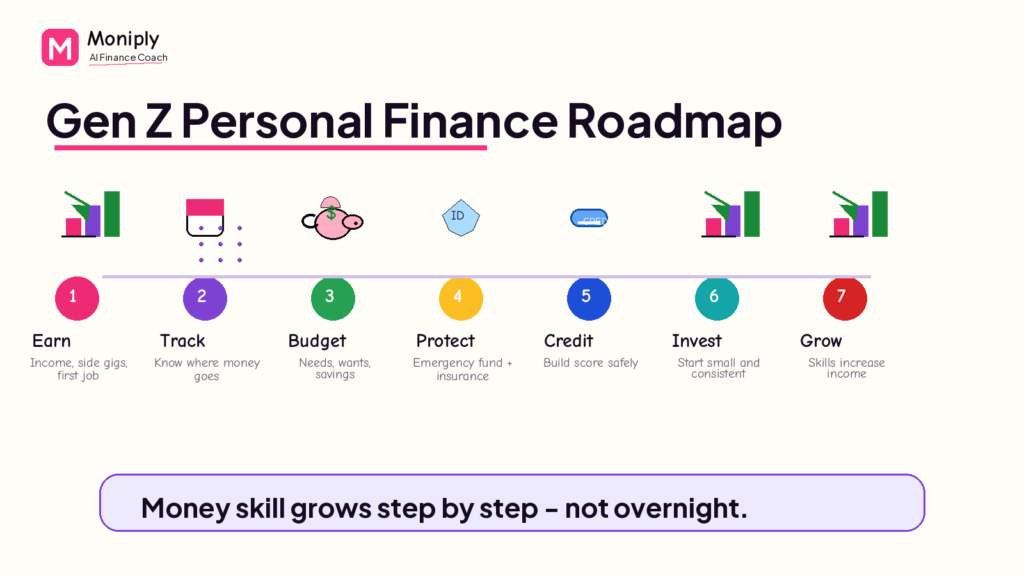
This guide is written for Gen Z beginners who want a clear, practical starting point. You do not need to be rich, perfect, or highly technical. You need a simple money system that helps you earn, track, save, spend wisely, avoid harmful debt, build credit, and grow long-term wealth step by step.
Google’s own content guidance recommends creating helpful, reliable, people-first content rather than pages made only to manipulate rankings. That is the same approach we will use here: practical advice, real examples, and clear steps that a beginner can actually follow.
What Personal Finance Means for Gen Z
Personal finance means how you manage your money in everyday life, from budgeting and expense tracking to saving, debt payoff, credit, and investing. It includes your income, spending, budget, bills, debt, savings, emergency fund, credit, investing, insurance, taxes, and future goals.
For Gen Z, personal finance is not only about becoming rich one day. It is about building options. Money skills can help you move out, avoid debt stress, travel without regret, buy things intentionally, support family when needed, start a business, invest early, and feel less anxious about bills.
Good personal finance does not require a perfect life. It requires awareness and consistent small actions.
Why Gen Z Needs a Money System Early
The Federal Reserve’s household well-being research shows that many adults continue to feel pressure from prices, expenses, and financial shocks. In its 2025 household well-being report, the Federal Reserve noted that financial well-being remained uneven and that price increases were still a major concern for many households.
That matters for young adults because early money habits become adult patterns. If your first years of earning are built around impulse spending, credit card balances, and no savings, your future becomes harder. If your first years are built around tracking, saving, learning credit, and investing gradually, your future becomes more flexible.
The Consumer Financial Protection Bureau also provides resources for students and young consumers around managing money, building credit, saving or paying for college, and repaying student debt. These are exactly the areas where Gen Z needs a simple foundation.
The 7-Part Personal Finance System
A beginner money system can be divided into seven parts:
- Income: money coming in.
- Spending: money going out.
- Budgeting: your plan for each month.
- Savings: money kept for short-term protection and goals.
- Debt: borrowed money that must be managed carefully.
- Credit: your reputation with lenders.
- Investing: money used to build long-term wealth.
You do not need to master everything in one week. Start with the first two: income and spending. Then build the rest.
Step 1: Know Your Real Income
Your budget should start with real take-home income, not the salary number you see in a job offer. Take-home income is what actually lands in your bank account after taxes, deductions, contributions, or fees.
For Gen Z, income may come from many sources: part-time work, full-time salary, freelancing, online work, content creation, tutoring, delivery work, internships, scholarships, family support, or a small business.
If your income is irregular, use a low-average number. For example, if your monthly income ranges from $1,200 to $2,000, build your basic budget on $1,200. Extra money can go to emergency savings, debt payoff, or future goals.
Beginner action
Write down every source of income and separate guaranteed income from uncertain income. This helps you avoid spending money before it arrives.
Step 2: Track Where Your Money Goes
You cannot improve money you do not measure. A simple expense tracker can help Gen Z beginners spot subscriptions, food delivery, shopping, and lifestyle spending patterns.
Review your last 30 days of bank transactions, cash spending, digital wallets, subscriptions, and card payments. Group your spending into simple categories: housing, food, transport, phone, subscriptions, shopping, entertainment, education, personal care, debt, savings, and family support.
Many Gen Z budgets leak money through small repeated expenses: food delivery, rideshares, streaming services, gaming purchases, app subscriptions, coffee, online shopping, and buy-now-pay-later payments.
Tracking shows the truth. Once you see the pattern, you can change it.
Step 3: Create a Simple Monthly Budget
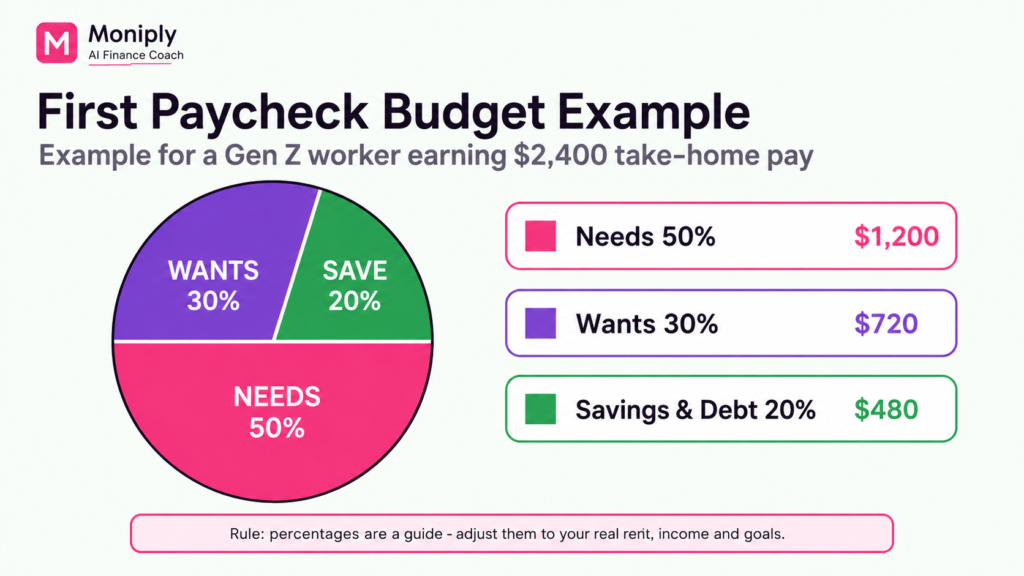
A budget is a plan for your money before the month starts. It tells your income where to go instead of wondering where it went.
For a deeper step-by-step system, read Moniply’s monthly budget guide before setting your first budget.
| Budget Area | Percentage | What It Covers |
|---|---|---|
| Needs | 50% | Rent, food, utilities, transport, insurance, required bills |
| Wants | 30% | Dining out, shopping, entertainment, travel, hobbies |
| Savings and debt | 20% | Emergency fund, extra debt payments, investing, future goals |
Use this as a monthly budget starting guide, not a strict rule. If rent is high, needs may be more than 50%. If you live with family, you may be able to save more than 20%.
Example: $2,400 take-home income
| Category | Amount |
|---|---|
| Needs 50% | $1,200 |
| Wants 30% | $720 |
| Savings and debt 20% | $480 |
If this does not fit your real life, adjust it. A realistic budget beats a perfect budget you ignore.
Step 4: Build a Starter Emergency Fund
An emergency fund is cash set aside for unexpected expenses or financial emergencies. The CFPB describes emergency savings as money reserved for unplanned expenses such as car repairs, home repairs, medical bills, or loss of income.
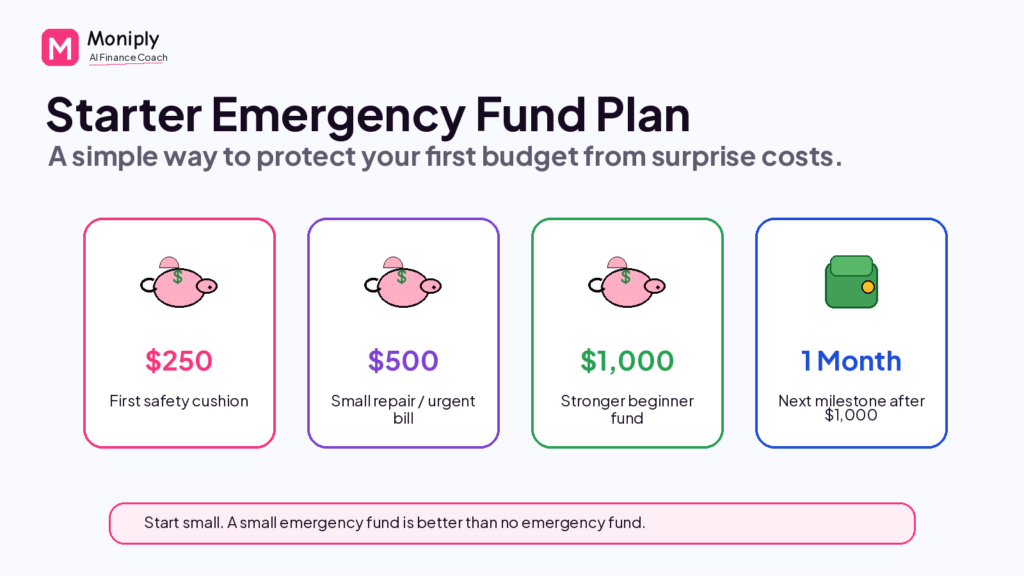
For beginners, do not worry about saving six months of expenses immediately. Start with smaller milestones:
- $250 starter emergency fund
- $500 beginner safety cushion
- $1,000 stronger starter fund
- One month of basic expenses
- Three to six months of expenses over time
You can also use an emergency fund calculator to estimate your first realistic savings target.
This fund protects you from turning every surprise into credit card debt. Keep emergency savings separate from everyday spending money so you are less tempted to use it.
Step 5: Understand Needs vs Wants
Needs are expenses required for safety, basic living, work, education, or health. Wants are things that improve your lifestyle but are not required for survival or basic stability.
The difficult part is that many wants feel like needs. A phone may be a need, but the newest expensive phone may be a want. Clothing is a need, but constant trend shopping may be a want. Food is a need, but daily delivery may be a want.
This does not mean you should never enjoy money. It means you should spend intentionally. The goal is not to remove fun. The goal is to stop unconscious spending from stealing your future goals.
Step 6: Use Credit Carefully
Credit can help you rent an apartment, finance a car, qualify for better rates, and build financial options. It can also create long-term stress if used carelessly.
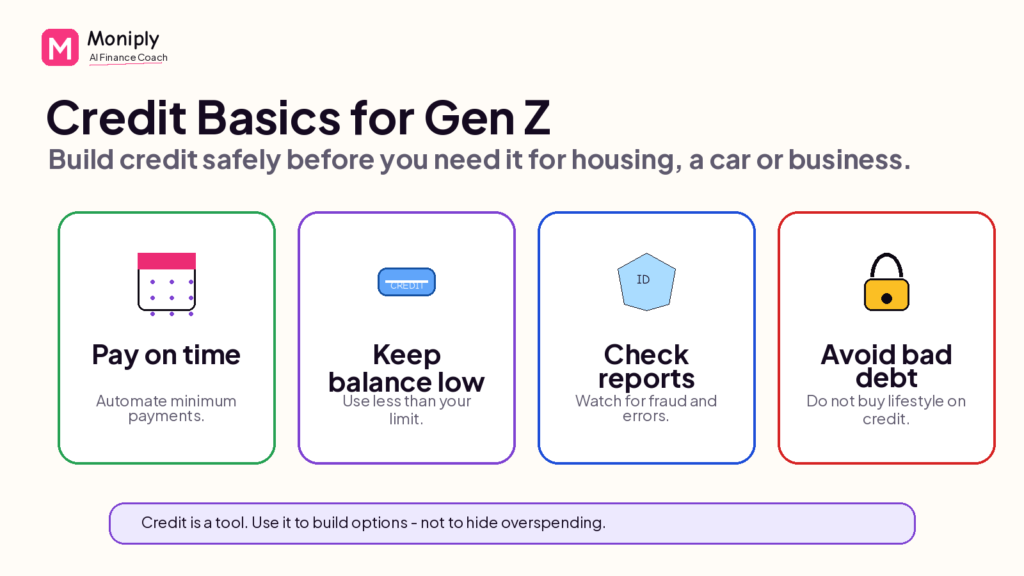
The most important credit habits are simple:
- Pay every bill on time.
- Keep credit card balances low.
- Do not carry a balance just to “build credit.”
- Use credit for planned purchases, not emotional spending.
- Check your credit reports and watch for fraud.
- Avoid applying for many credit products at once.
Credit is not free money. It is borrowed money with rules. If you use a credit card, try to pay it in full each month. If you cannot pay it in full, stop using it until the balance is under control. If credit card balances are already growing, a credit card payoff calculator can show how long repayment may take.
Step 7: Be Careful With Buy-Now-Pay-Later
Buy-now-pay-later services can look harmless because each payment is small. But small payments across several apps can quietly become a large monthly burden.
Before using any installment payment, ask:
- Would I still buy this if I had to pay full price today?
- Do I already have other installment payments?
- Will this payment affect my rent, food, savings, or bills?
- Is this a need or a trend-driven want?
If you use buy-now-pay-later, track it in your budget like debt. Do not hide it from your spending plan.
Step 8: Start Saving Before You Feel Ready
Many beginners wait to save until they have “extra” money. The problem is that extra money rarely appears by accident.
Start with a small automatic transfer. Even $10, $20, or $50 per paycheck builds the habit. Once the habit exists, increase the amount when income grows.
Savings goals for Gen Z may include an emergency fund, education, moving out, travel, a car, a laptop, business startup costs, family support, wedding expenses, or professional certification, and a savings goal tracker can make these goals easier to follow.
Step 9: Learn the Basics of Investing
Investing means putting money into assets that may grow over time, such as index funds, retirement accounts, or other long-term investments. Investing is different from saving. Savings are for short-term safety. Investing is for long-term growth and includes risk.
Beginners should build basic stability first: budget, emergency fund, high-interest debt control, and credit safety. After that, investing small amounts consistently can be powerful because Gen Z has time.
Important beginner rules:
- Do not invest emergency money.
- Do not invest money needed for rent or bills.
- Understand risk before investing.
- Avoid “get rich quick” trading pressure.
- Prefer long-term learning over hype.
- Start small and stay consistent.
Investing should not feel like gambling. It should be part of a patient long-term plan.
Step 10: Protect Yourself From Scams and Fraud
Gen Z lives online, which creates opportunity and risk. Fake investment platforms, crypto scams, phishing messages, job scams, fake shopping sites, romance scams, and account takeover attempts are common online threats.
Protect yourself with simple habits:
- Do not click money links from unknown messages.
- Use strong passwords and two-factor authentication.
- Do not share one-time codes.
- Research apps before connecting bank details.
- Avoid investment promises that sound guaranteed.
- Check account activity regularly.
If something promises fast money with no risk, be careful.
Step 11: Grow Your Income Skills
Cutting expenses helps, but income growth matters too. Gen Z has access to many skill-building paths: digital marketing, bookkeeping, coding, design, writing, sales, video editing, data analysis, tutoring, operations support, virtual assistance, and AI-assisted productivity.
The best skill is one that matches your strengths, market demand, and ability to practice consistently.
Use some of your budget for self-investment when possible: courses, books, certifications, tools, networking, portfolio projects, or mentorship.
Step 12: Build Your First Net Worth Statement
Net worth is what you own minus what you owe, and a net worth tracker helps you monitor whether your financial position is improving.
The formula is simple:
| Assets | Minus Liabilities | Equals Net Worth |
|---|---|---|
| Cash, savings, investments, valuable property | Credit cards, loans, unpaid balances | Your financial position |
Do not be discouraged if your net worth is low or negative at the beginning. The purpose is to track progress. Your first goal is not to look rich. Your first goal is to move in the right direction.
Common Gen Z Money Mistakes
- Spending based on social media pressure: Trends move faster than income.
- Ignoring small subscriptions: Small monthly charges add up.
- Using credit for lifestyle: Debt should not replace income.
- Waiting too long to save: Small savings are still progress.
- Trying to invest before learning basics: Hype can be expensive.
- Not protecting accounts: Online fraud can damage finances quickly.
- Avoiding money conversations: Silence keeps problems hidden.
A Simple 30-Day Money Challenge for Gen Z
Week 1: Awareness
- List all income sources.
- Track every expense for seven days.
- Cancel one subscription you do not use.
Week 2: Budget
- Create a simple monthly budget.
- Separate needs, wants, savings, and debt.
- Set one spending limit for a problem category.
Week 3: Savings
- Open or separate an emergency fund.
- Save your first small amount.
- Set a target of $250, $500, or $1,000.
Week 4: Credit and Growth
- Check your credit or learn how credit works in your country.
- Make a plan to pay every bill on time.
- Choose one income skill to improve this month.
How Moniply Helps Gen Z Manage Money
Moniply is built to make personal finance easier for beginners. It helps organize income, spending, budgets, savings goals, debt payoff, receipts, invoices, reports, net worth, and AI finance coaching in one place.
For Gen Z, this matters because money decisions happen fast. The easier your system is, the more likely you are to use it.
Instead of guessing where your money went, Moniply helps you see your money picture clearly. You can track spending categories, check budget progress, plan savings goals, review debts, and learn from your patterns.
Personal Finance by Gen Z Life Stage
Gen Z is not one single financial situation. Some are still in school. Some are in their first job. Some are freelancers or creators. Some are young parents. Some are already supporting family members. Your money plan should match your real stage of life.
If You Are Under 20
Your main goal is learning money awareness before large responsibilities arrive. Focus on tracking small spending, understanding needs versus wants, avoiding unnecessary debt, saving from gifts or part-time income, and learning how bank accounts, cards, and digital wallets work. Do not compare your finances with influencers or older adults. Your advantage is time and the ability to build good habits early.
If You Are in Your Early 20s
Your focus should be first income, first rent, student loans, transportation, credit building, and emergency savings. This is the age where lifestyle inflation can start. When income rises, avoid upgrading every part of your life at once. Keep your fixed costs low if possible and save before spending on trends, travel, gadgets, or fashion.
If You Are in Your Mid-to-Late 20s
Your focus should shift toward stronger savings, career growth, debt reduction, investing basics, insurance, and long-term goals. You may be thinking about moving cities, starting a business, getting married, supporting parents, buying a car, or planning home ownership. Your budget should now include future categories, not only current spending.
If You Are a Student
Students should focus on controlling flexible spending, managing education costs, avoiding unnecessary credit card debt, and building a simple emergency fund. A student budget should include books, transport, food, phone, software, school supplies, social spending, and savings. If you use student loans, understand repayment terms before borrowing more.
If You Are a Freelancer or Creator
Freelancers, creators, and gig workers need a different system because income can change every month. Use a low-income baseline, separate business and personal money, set aside money for taxes, track equipment and software costs, and build a larger emergency fund. Do not build your lifestyle around your best income month. Build it around your reliable average.
If You Are a Young Parent
Young parents need a budget that protects essentials first: housing, food, childcare, healthcare, transport, baby needs, school costs, and emergency savings. The best money system for a young parent is simple, visible, and realistic. You may not be able to save a large amount immediately, but even small planned savings can reduce stress during emergencies.
How to Handle Your First Paycheck
Your first paycheck is exciting, but it can disappear quickly if there is no plan. Before spending it, divide it into jobs.
| Paycheck Job | Example Percentage | Purpose |
|---|---|---|
| Needs | 50% | Rent, food, transport, phone, bills |
| Wants | 25% to 30% | Fun, eating out, shopping, hobbies |
| Emergency savings | 10% | Build your starter safety fund |
| Debt or investing | 5% to 10% | Extra debt payoff or beginner investing |
| Family or giving | Optional | Support obligations, gifts, or charity |
This split is only a starting point. If you live at home, you may save more. If rent is high, needs may take more. The important rule is to decide before spending.
How to Budget When Friends Spend More Than You
One of the hardest money challenges for Gen Z is social pressure. Friends may want expensive dinners, concerts, trips, shopping, or activities that do not fit your budget. Saying no can feel uncomfortable, but financial confidence requires boundaries.
Try these simple responses:
- “I’m saving this month, but I can join for coffee instead.”
- “That trip is outside my budget, but I’m in for a lower-cost plan.”
- “I’m trying to stick to my money goals, so I’ll skip this one.”
- “Let’s do something free or cheaper this weekend.”
You do not need to explain every detail of your finances. A healthy budget includes social life, but it should not be controlled by other people’s spending habits.
Budget Categories Gen Z Should Not Forget
Many beginner budgets include rent and food but forget the real-life categories that appear later. Add these categories to avoid surprise spending:
- Annual subscriptions and app renewals
- Phone upgrades or repairs
- Clothing and shoes
- Medical appointments and medicine
- Transportation repairs or ride-share costs
- Gifts, weddings, birthdays, and holidays
- Travel and vacation savings
- Course fees, exams, and certifications
- Work tools, software, or professional equipment
- Emergency family support
These are not always monthly expenses, but they are real expenses. Plan for them monthly so they do not become debt later.
Simple Money Rules Every Gen Z Beginner Should Know
- Spend less than you earn: This is the base of every financial plan.
- Save before spending: Move savings first, not after everything else.
- Keep fixed costs low: Rent, car payments, and debt can trap your income.
- Use credit like a tool: Build history, but avoid carrying balances.
- Do not invest money you need soon: Short-term money belongs in safer savings.
- Track subscriptions: Cancel what you do not use.
- Review money weekly: Small reviews prevent big mistakes.
- Increase income skills: Your earning power is one of your biggest assets.
A Beginner Monthly Money Routine
A routine makes personal finance easier because you do not need to make every decision from zero. Use this routine each month:
Before the Month Starts
- Estimate income.
- List bills and due dates.
- Set spending limits.
- Choose one savings goal.
- Check upcoming events and irregular expenses.
Every Week
- Review spending categories.
- Check account balances.
- Look at upcoming bills.
- Pause spending if one category is too high.
- Move any extra money to savings or debt payoff.
End of the Month
- Compare planned versus actual spending.
- Identify one mistake and one win.
- Update next month’s budget.
- Review savings and debt progress.
- Celebrate progress without overspending.
The goal is not to become a finance expert overnight. The goal is to repeat a simple system until money feels less random.
Frequently Asked Questions
What is the first personal finance step for Gen Z?
The first step is to know your real income and track your spending. You cannot build a strong budget until you know what money comes in and where it goes.
How much should Gen Z save each month?
A helpful starting target is 10% to 20% of take-home income, but any consistent saving is better than waiting. Start small and increase over time.
Should Gen Z use credit cards?
Credit cards can help build credit if used responsibly. Pay on time, keep balances low, and avoid carrying debt for lifestyle spending.
Is investing important for Gen Z?
Yes, but investing should come after basic stability. Build a budget, create emergency savings, control harmful debt, then start learning long-term investing.
What is the biggest money mistake young adults make?
One common mistake is spending based on social pressure instead of personal goals. Another is ignoring small recurring expenses that quietly reduce savings.
How can Gen Z avoid money stress?
Use a simple system: track spending, budget monthly, save automatically, avoid harmful debt, and review money weekly.
Financial Disclaimer
This article is for educational purposes only and does not provide personal financial, investment, legal, or tax advice. Financial situations vary by country, income, family situation, and personal goals. Consider speaking with a qualified professional before making major financial decisions.
Final Thoughts
Personal finance for Gen Z does not have to be complicated. Start with the basics: know your income, track your spending, build a budget, save a starter emergency fund, use credit carefully, protect yourself from scams, and learn skills that grow your income.
You do not need to become perfect. You need to become consistent. Every good money habit you build early gives your future self more choices.
Small steps today can create better money confidence tomorrow.
Turn this guide into a practical money plan
Use the relevant Moniply tool, review your numbers, then join the app waitlist for AI-guided money habits.
Get the Moniply AI Finance Coach app
Moniply is building an Android app that turns budgeting, savings, debt payoff, and money decisions into simple AI-guided next steps.

Author: M.Adil
Finance professional and Moniply founder. Moniply helps everyday people use simple tools, practical guides, and AI-style money coaching to budget, save, and make calmer financial decisions.