Creating a monthly budget sounds simple until real life happens. Rent increases. Groceries cost more than expected. A bill arrives early. A birthday, school fee, car repair, medical cost, travel plan, or family obligation suddenly appears. Then the “perfect” budget you made at the start of the month stops working.
That is why a good monthly budget in 2026 should not be strict, complicated, or based on guessing. It should be realistic. It should help you understand where your money goes, what must be paid first, what can be reduced, and how much you can safely save or use for debt repayment.
A monthly budget is not about punishing yourself. It is a plan for giving your money a clear job before the month controls you.
The Consumer Financial Protection Bureau recommends building a realistic picture of money coming in and going out before deciding how much can go toward savings or debt goals. The same principle applies to every household: know your income, know your spending, and plan before the money disappears.
This guide explains how to create a monthly budget that works for real people: students, Gen Z workers, families, freelancers, single parents, professionals, and anyone trying to get control of money without feeling overwhelmed.
What Is a Monthly Budget?
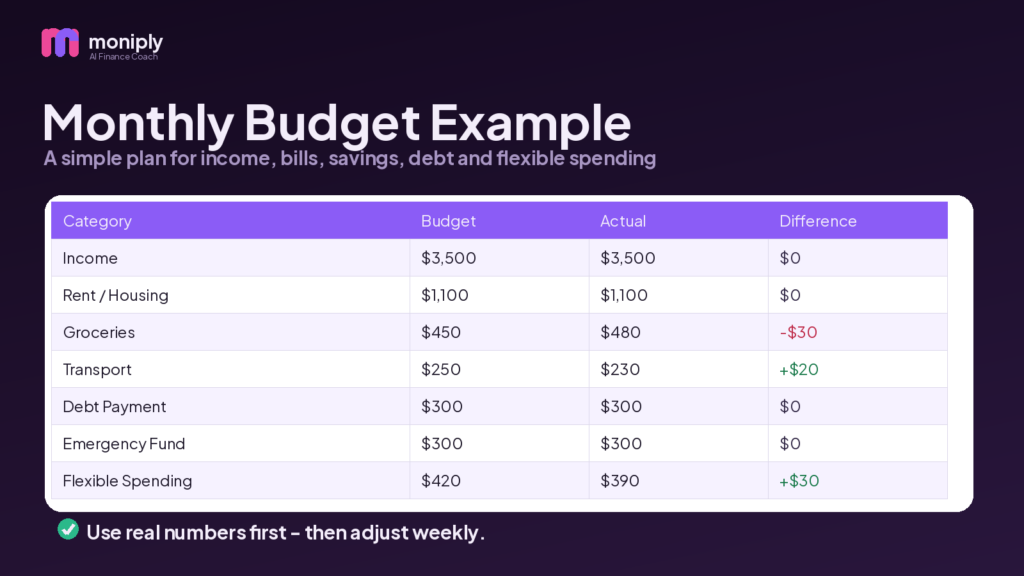
A monthly budget is a written plan for your income and expenses during one month, and using a simple budget planner can make the process easier. It shows how much money you expect to receive, what bills and essentials must be paid, how much you can spend on flexible categories, and how much should go toward savings, debt, or future goals.
A budget is not just a list of expenses. It is a decision-making tool. It helps you answer practical questions like: Can I afford this purchase? Am I overspending on food, shopping, or subscriptions? How much can I save this month? Which debt should I pay first? Why do I feel broke even after getting paid?
The best budget is not the one that looks perfect on paper. The best budget is the one you can actually follow.
Why Monthly Budgeting Still Matters in 2026
Budgeting matters more in 2026 because many households are dealing with higher living costs, subscription creep, lifestyle pressure, travel spending, debt payments, and irregular income. Even when income is stable, expenses can shift quickly.
The U.S. Bureau of Labor Statistics reported that average annual household expenditures in the United States were $78,535 in 2024, equal to about $6,545 per month. Housing and transportation accounted for more than half of that spending. Housing averaged $2,189 per month and transportation averaged $1,110 per month.
That matters because most people do not lose control of money because of one small coffee or one shopping trip. Budgets usually break because large fixed costs and repeated flexible spending quietly take over.
The Federal Reserve also reported that the share of adults who would cover a $400 emergency expense using cash or its equivalent remained at 63% in 2025. This means many people still need stronger emergency savings and better monthly planning.
A monthly budget helps you prepare before the emergency happens.
Step 1: Start With Your Real Take-Home Income
The first step is to calculate your real monthly income. Do not start with your gross salary unless you actually receive that amount. Use your take-home income after taxes, deductions, retirement contributions, insurance, or other automatic deductions.
Include salary or wages, freelance income, business income, side hustle income, rental income, support payments, or any regular monthly cash inflows.
If your income changes every month, use a conservative number. For example, if your freelance income is usually between $2,000 and $3,200, build your budget around $2,000 or $2,200, not the best month. This protects you from overspending before the money arrives.
Example
If your salary is $4,000 before deductions but your bank receives $3,250, then your budget should start with $3,250. If you earn $2,500 from a job and usually make $400 from freelancing, you can budget with $2,500 as guaranteed income and treat the freelance money as extra for savings, debt payoff, or irregular expenses.
Step 2: List Your Fixed Bills First
Fixed bills are the expenses you must pay every month. These usually have a due date and are harder to avoid. Examples include rent or mortgage, internet, phone bill, insurance, loan payments, credit card minimum payments, school fees, childcare, subscriptions, car payment, and utilities.
Write down the amount and due date for each bill. This is important because timing matters. A person can earn enough money for the month but still run into trouble if too many bills are due before the next paycheck.
| Bill | Amount | Due Date | Paid? |
|---|---|---|---|
| Rent | $950 | 5th | No |
| Internet | $45 | 8th | No |
| Phone | $60 | 12th | No |
| Car payment | $300 | 18th | No |
| Credit card minimum | $75 | 22nd | No |
Step 3: Track Your Flexible Spending
A good expense tracker helps you see these flexible spending leaks before they damage your monthly budget. These are expenses that change from month to month: groceries, dining out, transport, fuel, clothing, entertainment, beauty and grooming, gifts, travel, home decor, online shopping, food delivery, and hobbies.
You do not need to track every cent forever, but you should track enough to understand your patterns. Use your last 30 to 90 days of bank statements, cash notes, receipts, or app records. Look for repeated categories.
Ask: How much did I spend on food? How much was planned? How much was emotional or impulse spending? Which categories surprise me? What expenses happen every month but are not in my budget?
This is where a tool like Moniply can help because it groups spending, tracks categories, and shows what is left.
Step 4: Choose a Budgeting Method That Fits Your Life
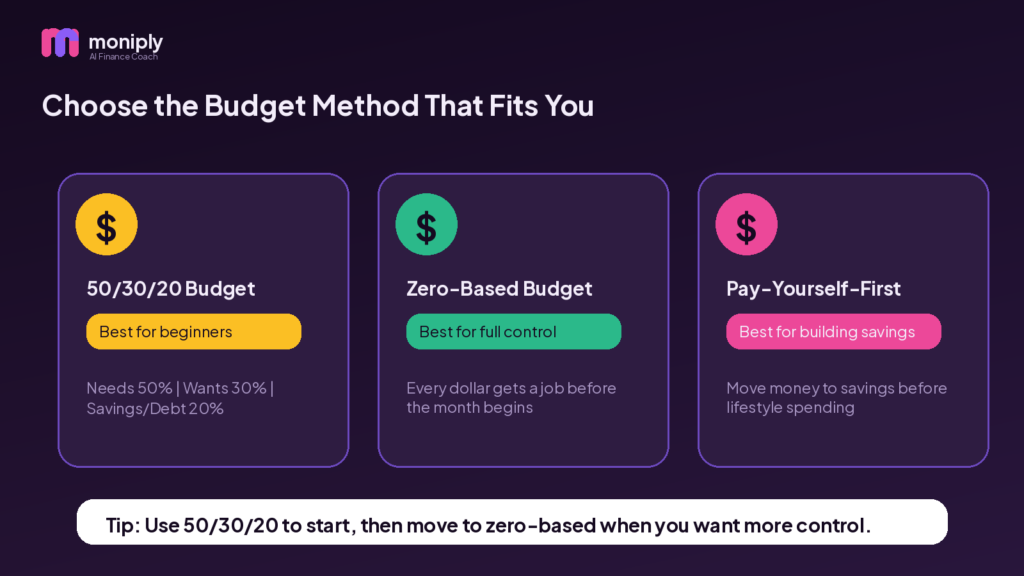
Many people fail at budgeting because they choose a method that does not match their income, personality, or lifestyle. There are several simple methods.
The 50/30/20 Budget
The 50/30/20 budget is one of the easiest starting points. It divides after-tax income into 50% for needs, 30% for wants, and 20% for savings and debt repayment.
| Category | Percentage | Example on $3,000 Income |
|---|---|---|
| Needs | 50% | $1,500 |
| Wants | 30% | $900 |
| Savings and Debt | 20% | $600 |
You can also use Moniply’s 50/30/20 budget calculator to quickly divide your income into needs, wants, savings, and debt.
This method is good for beginners because it is simple. But it is not perfect for everyone. If rent, food, transport, and bills already take 70% of your income, use the rule as a guide, not a strict law.
Zero-Based Budget
A zero-based budget gives every dollar a job. If you earn $3,000, your budget should assign all $3,000 to bills, spending, savings, debt, or goals. This does not mean you spend everything. Savings and debt payments are also jobs for your money.
Pay-Yourself-First Budget
Pay-Yourself-First Budget method puts savings first. Before spending on wants, you move money to an emergency fund, retirement, debt payoff, investment account, travel fund, family goal, or big purchase fund. Then you budget the rest.
Step 5: Build Your Monthly Budget Categories
A working monthly budget needs clear categories. Start with income, fixed bills, essentials, flexible spending, savings and goals, debt payoff, and irregular expenses.
For bigger goals like an emergency fund, travel fund, or car fund, a savings goal tracker can help you stay consistent.
Irregular expenses are the category most people forget. These include car repairs, annual insurance, birthdays, holidays, back-to-school shopping, medical visits, tax payments, home repairs, travel, and seasonal clothing. Divide annual or occasional costs by 12. If your yearly car insurance is $600, budget $50 per month.
Step 6: Add a Buffer Category
Every budget needs a buffer. A buffer is a small amount of money set aside for things you forgot or underestimated. If your budget is too tight, one unexpected cost can break it.
You can estimate your safety cushion with an emergency fund calculator before deciding how much to keep aside each month.
Start with $50 to $200 per month or 2% to 5% of income. Use it for small surprises, not impulse shopping.
Step 7: Plan by Paycheck Timing
A monthly budget shows the big picture, but paycheck timing decides whether the plan works. If you are paid twice per month, split bills by paycheck.
For example, the first paycheck can cover rent, internet, groceries, fuel, and savings. The second paycheck can cover phone, insurance, credit card, utilities, groceries, and personal spending.
Step 8: Use a Weekly Check-In
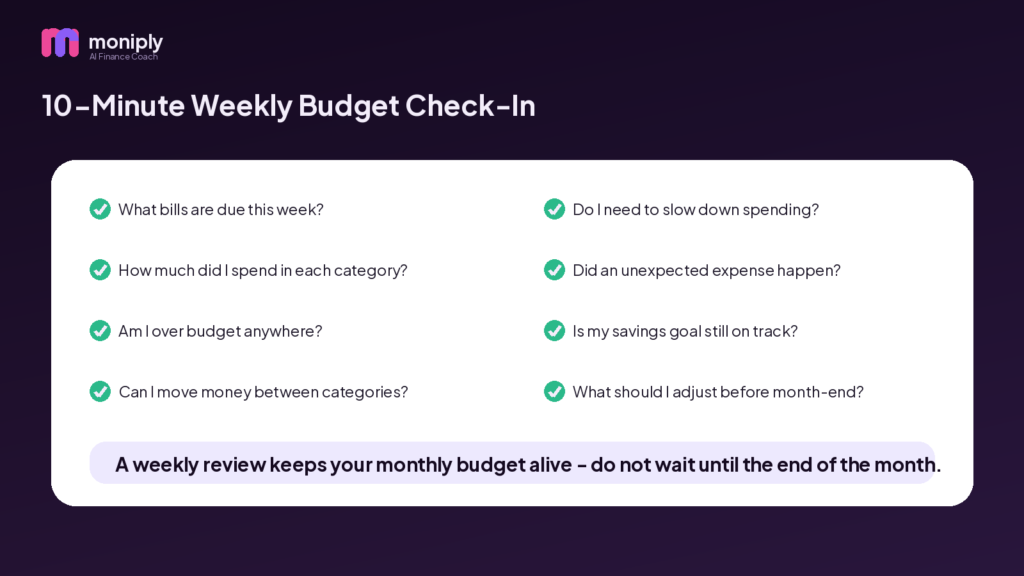
A budget should not be something you create once and ignore. Check it weekly. Ask what bills are due this week, how much you have spent in each category, whether you are over budget, whether you can move money from one category to another, and whether you need to slow down spending.
A weekly check-in takes 10 to 15 minutes and can save the whole month.
Step 9: Adjust Instead of Quitting
Most people quit budgeting because they think going over budget means failure. It does not. A budget is a plan, not a prison.
If groceries are $80 higher than expected, adjust. Reduce dining out, shopping, entertainment, or next week’s flexible spending. If your transport cost increases, update the budget. If income drops, rewrite the budget quickly instead of pretending nothing changed.
Budgeting by Age: What to Focus On
Under 20
Focus on learning needs versus wants, avoiding unnecessary debt, saving small amounts, understanding bank accounts, and tracking spending habits.
In Your 20s
Focus on emergency fund, student loans, first job income, rent and bills, avoiding lifestyle inflation, building credit carefully, and learning Gen Z money basics early.
In Your 30s
Focus on family budget, housing costs, insurance, childcare, debt payoff, retirement contributions, and a bigger emergency fund.
In Your 40s
Focus on retirement acceleration, education costs, mortgage or rent planning, investment consistency, insurance review, and reducing high-interest debt.
In Your 50s
Focus on retirement readiness, healthcare planning, debt reduction, travel planning, supporting children or parents, and increasing savings rate.
60 and Above
Focus on fixed income planning, healthcare, housing stability, emergency cash, low-risk spending, estate planning, and family support planning.
Budgeting for Different Life Situations
Gen Z
Gen Z budgets should focus on flexibility. Many young adults deal with first jobs, gig income, online subscriptions, food delivery, travel pressure, fashion spending, and social media-driven lifestyle expectations. Best tip: automate savings before lifestyle spending grows.
Single Moms
Single moms need a budget that protects essentials first: housing, food, childcare, transport, school costs, medical needs, and emergency savings. Best tip: create sinking funds for school, clothing, health, and holidays.
Families
Family budgets need shared visibility. Both partners should know total income, bills, child-related costs, debt, savings goals, and spending limits. Best tip: schedule one family money meeting per month.
Freelancers
Freelancers need irregular income budgeting. Use a low-income baseline, tax savings account, emergency fund, business expense category, and separate personal and business accounts. Best tip: budget from last month’s income, not expected income.
Doctors and Busy Professionals
High income does not guarantee good budgeting. Professionals often face lifestyle inflation, loans, insurance, family support, and limited time. Best tip: automate bill payments, savings, investments, and debt repayment.
Common Monthly Budget Mistakes
- Guessing expenses: Use real transaction history instead of estimates.
- Forgetting irregular costs: Plan birthdays, holidays, repairs, school fees, renewals, and travel monthly.
- Making the budget too strict: If there is no room for enjoyment, the budget will fail.
- Ignoring small spending: Small repeated purchases can become large monthly leaks.
- No emergency fund: Without emergency savings, every surprise becomes debt.
- Not reviewing weekly: A budget without review becomes outdated quickly.
Monthly Budget Example
| Category | Amount |
|---|---|
| Rent | $1,100 |
| Utilities | $180 |
| Groceries | $450 |
| Transport | $250 |
| Phone/Internet | $100 |
| Insurance | $150 |
| Debt Payment | $300 |
| Emergency Fund | $300 |
| Dining Out | $180 |
| Shopping | $150 |
| Entertainment | $120 |
| Subscriptions | $50 |
| Family/Gifts | $120 |
| Buffer | $150 |
| Total | $3,500 |
How Moniply Helps With Monthly Budgeting
Moniply is designed to make budgeting easier by bringing your money plan into one place. With Moniply, you can organize monthly income, expenses, bills, receipts and invoices, debt payoff, savings goals, net worth, reports, progress journey, and AI finance coaching.
Instead of guessing where your money went, Moniply helps you see patterns and make better decisions. If dining out is over budget, Moniply can show the category clearly. If bills are coming up, you can plan before the due date. If your savings goal is falling behind, you can adjust your spending before the month ends.
Monthly Budget Checklist
Before the Month Starts
- Add expected income.
- List all bills and due dates.
- Set category limits.
- Add savings goals.
- Add debt payments.
- Create a buffer.
- Plan irregular expenses.
During the Month
- Track spending weekly.
- Review upcoming bills.
- Adjust categories if needed.
- Avoid impulse spending.
- Move savings early.
At the End of the Month
- Compare planned versus actual spending.
- Identify overspending.
- Review savings progress.
- Check debt reduction.
- Plan next month better.
Frequently Asked Questions
A common starting point is 20% of take-home income, but the right amount depends on your income, debt, expenses, and goals. If 20% is too high, start smaller and increase over time.
Yes, it is useful as a simple starting point. But if your needs are more than 50%, adjust the percentages to fit real life.
The easiest budget for beginners is the 50/30/20 method or a simple category budget with income, bills, food, transport, savings, and flexible spending.
Most budgets fail because they are based on guesses, ignore irregular expenses, have no buffer, or are too strict to follow.
Use both. Create a monthly plan, then check it weekly.
Use your lowest expected monthly income as the base. Treat extra income as money for savings, debt payoff, taxes, or future months.
Financial Disclaimer
This article is for educational purposes only and does not provide personal financial, legal, or tax advice. Your financial situation may be different, so consider speaking with a qualified professional before making major financial decisions.
Final Thoughts
A monthly budget that actually works is not built on perfection. It is built on honesty. Know your income. List your bills. Track your spending. Save something. Plan for irregular costs. Review weekly. Adjust without quitting.
The goal is not to control every dollar forever. The goal is to stop money from feeling random. When your budget becomes realistic, your money becomes easier to manage, and your financial goals become easier to reach.
Turn this article into a monthly budget
Start with income, fixed costs, flexible spending, and one savings target. Then review your numbers in the dashboard.
Get the Moniply AI Finance Coach app
Moniply is building an Android app that turns budgeting, savings, debt payoff, and money decisions into simple AI-guided next steps.

Author: M.Adil
Finance professional and Moniply founder. Moniply helps everyday people use simple tools, practical guides, and AI-style money coaching to budget, save, and make calmer financial decisions.