Your credit score quietly shapes your financial life. It decides the interest you pay, the apartments you qualify for, and sometimes the jobs you land. A low score costs you money on every loan, while a high one saves thousands over a lifetime.
The encouraging part is that you can improve your credit score faster than most people believe. Scores respond to a handful of clear actions, and some of those actions move the needle within a single billing cycle. You do not need to be wealthy, only consistent.
This guide explains what a credit score is, the factors that build it, and the exact steps to improve your credit score. You will see a worked example of how a payment and utilization change can lift a score, plus answers to the questions people ask most. Start applying these today and watch the number climb.
What Is a Credit Score and Why It Matters

A credit score is a three-digit number, usually from 300 to 850, that lenders use to judge how reliably you repay debt. Higher means safer to lend to, which unlocks lower interest rates and better terms. Most scores fall into bands from poor to excellent.
The number matters because it follows you everywhere. A strong score can save you tens of thousands of dollars in interest over a mortgage, a car loan, and credit cards combined. Improving it is one of the highest-return money moves available to anyone.
The Five Factors That Build Your Score
Credit scores are not mysterious. They rest on five weighted factors, and knowing the weights tells you exactly where to focus your effort first.
| Factor | Weight | What It Means |
| Payment history | 35% | Paying on time, every time |
| Credit utilization | 30% | How much of your limit you use |
| Credit age | 15% | How long accounts have been open |
| Credit mix | 10% | Variety of credit types |
| New inquiries | 10% | Recent applications for credit |
Payment history and utilization together make up 65 percent of your score. That is the good news, because both are within your direct control. Nail those two and the rest follows naturally over time.
How to Improve Your Credit Score Step by Step

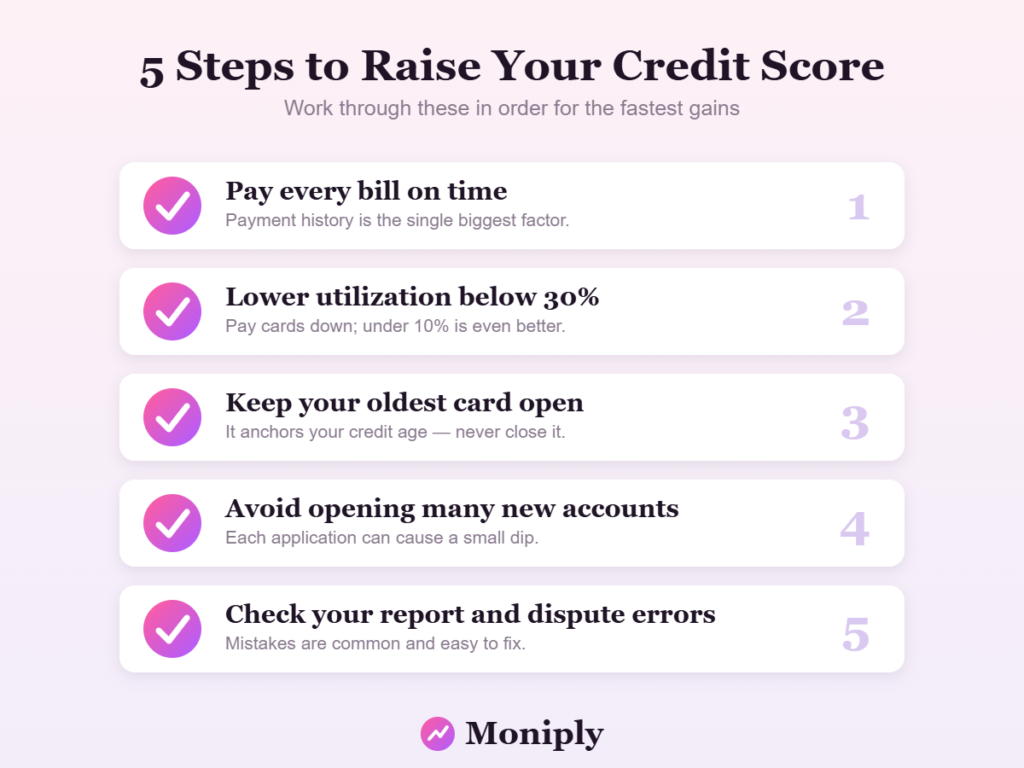
The fastest gains come from a clear order of actions. Work through these steps and you will improve your credit score in the shortest realistic time.
- Pay every bill on time, since payment history carries the most weight
- Lower your credit utilization below 30 percent, ideally under 10
- Never close your oldest credit card, as it anchors your credit age
- Avoid opening several new accounts in a short window
- Check your credit report and dispute any errors you find
Tip: Set every bill to autopay at least the minimum. A single missed payment can drop your score by 50 points or more, and on-time history is the biggest factor of all.
Worked Example: Lifting a Score in 90 Days
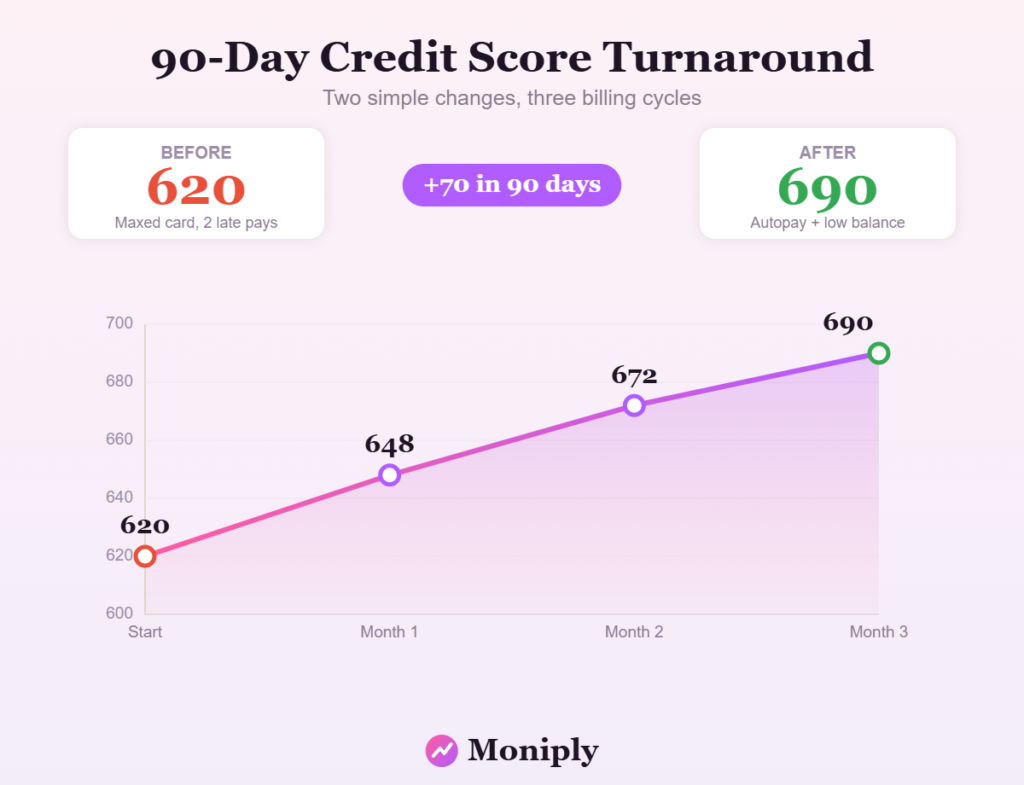
Picture someone with a score of 620 who carries a credit card maxed near its $5,000 limit and has missed two payments this year. Two changes can move that score meaningfully in about 90 days.
First, they set autopay so every future payment lands on time. Second, they pay the card down from $4,800 to $1,200, dropping utilization from 96 percent to 24 percent. As those changes report to the bureaus, the score can climb from 620 toward 690 within three billing cycles.
The lesson is clear. You do not need years to improve your credit score. Targeted moves on the two heaviest factors often produce visible gains in a single quarter, and steady habits push the number higher from there.
Habits That Keep Your Score High
Reaching a good score is one thing, holding it is another. The habits that build a score are the same ones that protect it: pay early, keep balances low, and leave old accounts open. Treat credit as a tool you control rather than a crutch you lean on.
Check your report at least once a year for errors, since mistakes are common and can quietly drag your score down. Catching and disputing them keeps your number accurate and protects you from fraud.
Mistakes That Hurt Your Credit Score
Some habits silently damage scores. Maxing out cards, paying late, closing old accounts, and applying for many cards at once all push the number down. Co-signing loans you cannot cover and ignoring your credit report add further risk.
Avoiding these pitfalls is half the battle. Many people could improve their credit score simply by stopping the behaviors that hurt it, before they ever add a single new positive action.
Start Improving Your Credit Score Today
Pull your credit report this week and look at two numbers: your payment history and your utilization. Set every bill to autopay and make a plan to pay your highest card down below 30 percent of its limit.
Those two moves alone can improve your credit score within months. A stronger score then saves you money on every loan you take for the rest of your life, which makes this one of the most valuable habits you can build.
Moniply AI Coach Upgrade
Connect credit score improvement with your budget
Improving your credit score is not only about credit cards. It is also about cash flow. When your budget gives you room to pay on time and lower balances, your score has a better chance to improve steadily.
Your next action plan
- Set payment reminders or automatic minimum payments for every account.
- Lower card balances before the statement closes when possible.
- Keep old positive accounts open unless there is a strong reason to close them.
- Avoid several new credit applications in a short period.
- Use your budget to decide how much extra you can put toward revolving balances.
AI Coach Tip: Payment history and utilization need a plan
The fastest score improvements usually come from on-time payments and lower utilization. Your budget helps you protect both by showing what you can pay before new spending starts.
Build your debt payoff plan
Compare payoff methods, check your monthly capacity, and turn this article into a step-by-step action plan.
Get the Moniply AI Finance Coach app
Moniply is building an Android app that turns budgeting, savings, debt payoff, and money decisions into simple AI-guided next steps.

Author: M.Adil
Finance professional and Moniply founder. Moniply helps everyday people use simple tools, practical guides, and AI-style money coaching to budget, save, and make calmer financial decisions.