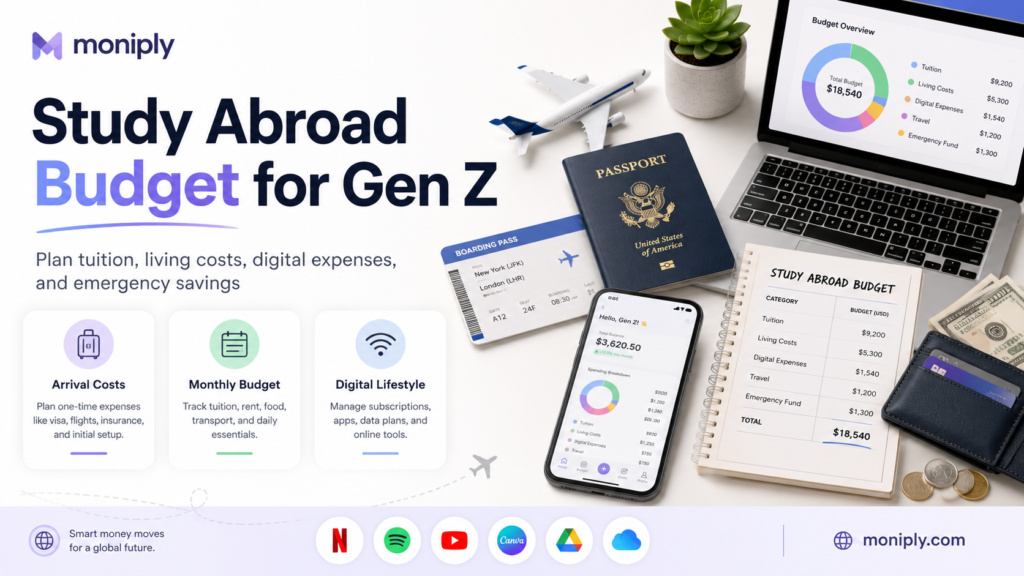
A study abroad budget for Gen Z needs to cover more than tuition, rent, groceries, and transport. For digital lifestyle users, money also follows the phone: eSIM data, cloud storage, music and video subscriptions, gaming, design or coding software, food delivery, ride-hailing, creator memberships, online shopping, device repairs, and spontaneous weekend travel. The goal is not to remove the digital lifestyle. It is to make the full cost visible before departure.
Why a Gen Z Study Abroad Budget Is Different
Previous generations could leave some costs at home. Gen Z students often carry a complete digital ecosystem across borders: multiple subscriptions, cloud accounts, banking apps, delivery platforms, online communities, remote work tools, and expensive personal devices.
These services make study and daily life easier, but recurring charges can continue in the home currency while new expenses begin in the destination currency.
A useful study abroad budget must therefore track three layers: education costs, local living costs, and digital lifestyle costs.
Start With the Total Cost – Not Tuition Alone
Tuition is only one part of the total study abroad cost. Add application and testing fees, visa or residence permit charges, passport renewal, medical examinations, translations, insurance, flights, baggage, local transport, temporary accommodation, housing deposits, basic furnishings, course materials, and emergency money.
EducationUSA advises students to begin financial planning early and notes that tuition, fees, housing, and food vary widely by institution and location. Financial aid and scholarships may be available, but competition can be high.
Create two totals before comparing destinations: one-time arrival costs and recurring monthly costs.
Build a One-Time Pre-Departure Budget
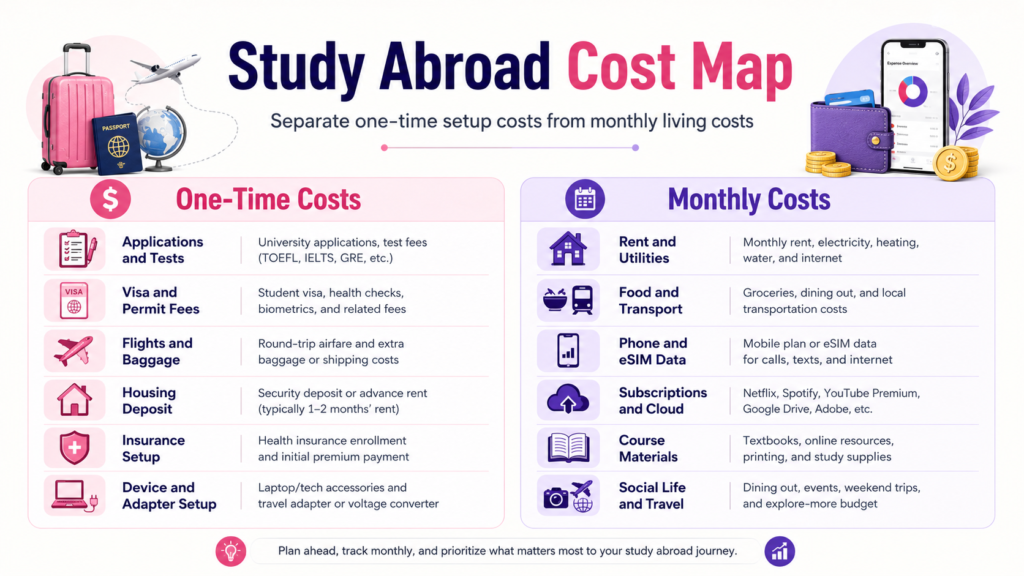
Application and admission: application fees, tests, credential evaluations, document translations, courier charges, and acceptance deposits.
Travel and legal setup: passport, visa or permit, biometric appointments, medical requirements, insurance, flights, baggage, airport transport, and temporary accommodation.
Housing setup: security deposit, first month of rent, bedding, kitchen basics, cleaning supplies, and utility or internet activation.
Digital setup: local SIM or eSIM, phone unlocking if needed, power adapters, laptop accessories, backup storage, device insurance, and replacement chargers.
Emergency setup: enough accessible money for several nights of accommodation, food, transport, medicine, and communication if housing, funding, or travel plans are delayed.
Create a Monthly Student Budget Abroad
Start with money you can reliably use each month: scholarship or stipend payments, family support, savings withdrawals, approved financial aid, and legal employment income where permitted.
Do not treat uncertain freelance work, future scholarships, or hoped-for part-time work as guaranteed income.
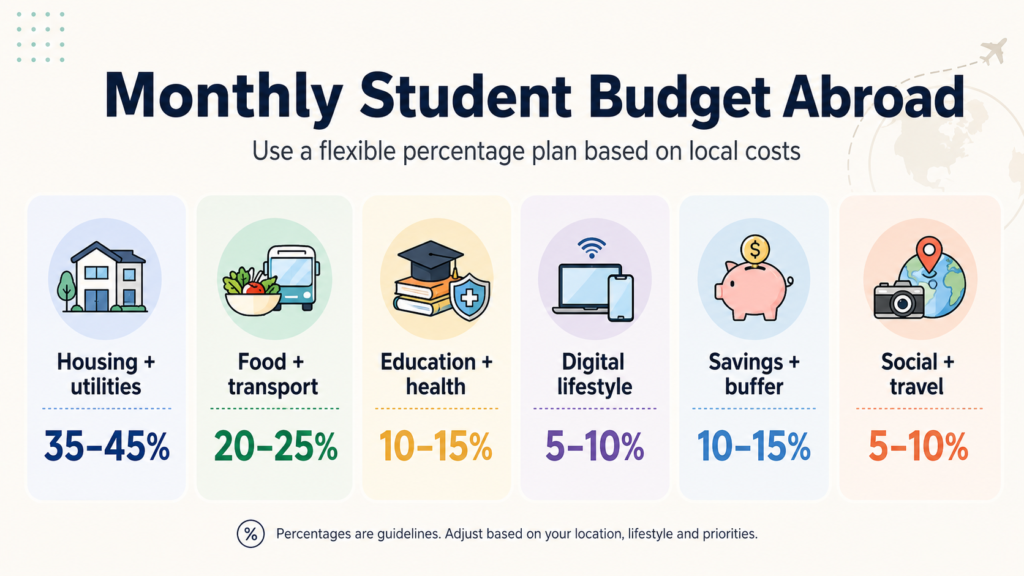
A flexible starting framework is 35% to 45% for housing and utilities, 20% to 25% for food and transport, 10% to 15% for education and health, 5% to 10% for digital lifestyle, 10% to 15% for savings and buffer, and 5% to 10% for social life or travel.
These percentages are not rules. Housing in a major city may require much more, while university accommodation or included meal plans may change the balance.
Illustrative Monthly Budget Example
Assume a student has the equivalent of $2,000 per month after tuition. An illustrative plan might assign $800 to housing and utilities, $360 to food and household needs, $140 to transport, $160 to education and health, $140 to digital lifestyle, $220 to savings and emergency buffer, and $180 to social life and local travel.
The example is not a price estimate for any destination. Convert the categories into the local currency and replace them with actual housing, transport, insurance, and food research.
Use the Moniply Budget Calculator to test several destinations or housing options before committing.
Audit Your Digital Lifestyle Before Departure
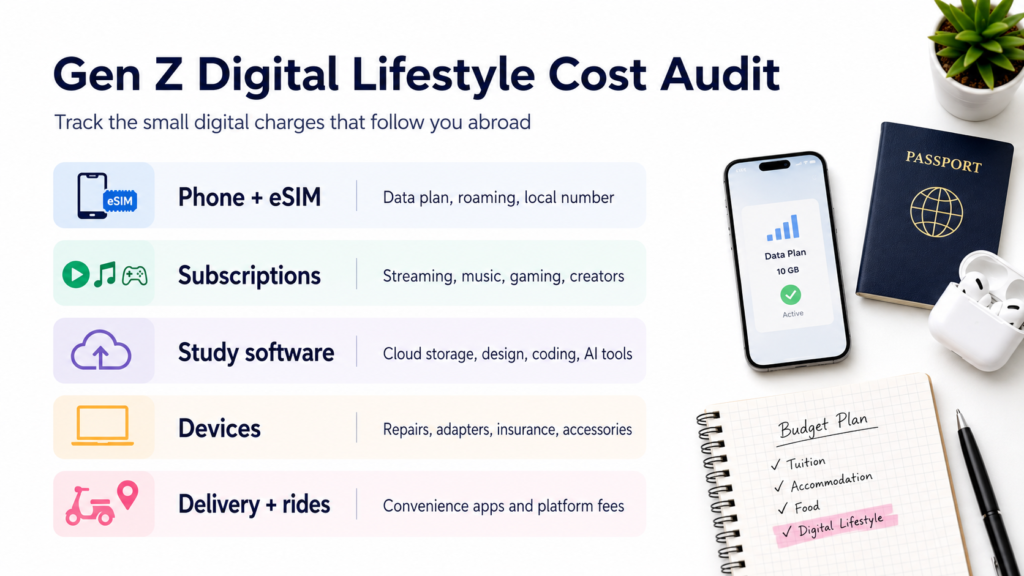
List every recurring digital charge: streaming, music, gaming, cloud storage, software, AI tools, creator memberships, phone installments, device insurance, VPN services, photo storage, premium social features, and online fitness or learning apps.
Mark each subscription as essential, useful, replaceable, or pauseable.
Check whether a student plan, annual plan, family plan, university licence, or free local alternative is available.
Pause subscriptions that will not work in the destination or that duplicate university services. Recheck the list after the first month abroad.
Budget for Phone, eSIM, Data, and Roaming
Compare local SIM and eSIM plans before departure, but confirm device compatibility, phone unlocking, identity requirements, hotspot limits, coverage, and renewal terms.
Keep access to the home number if it is required for banking or authentication, but avoid leaving an expensive roaming plan active by accident.
Download maps, documents, translations, and entertainment over trusted Wi-Fi before travel days. Monitor app background data and cloud photo uploads.
Store important account recovery information somewhere that does not depend on the same phone or SIM.
Plan Device and Technology Costs
A laptop or phone problem abroad can affect classes, banking, identity verification, travel, and communication at the same time.
Create a small technology sinking fund for repairs, adapters, chargers, headphones, storage, battery replacement, and emergency accessories.
Back up assignments and identity documents securely. Keep device serial numbers and purchase records where you can access them if a device is lost or stolen.
Check local laws and university policies before using privacy or network tools.
Control Food Delivery, Ride-Hailing, and Convenience Spending
Delivery and ride-hailing apps are useful during arrival, illness, late classes, bad weather, and unfamiliar routes. The problem begins when convenience becomes the default.
Create separate weekly limits for groceries, eating out, delivery fees, rides, and social spending. A single food category can hide the real cost of convenience.
Learn the safest public transport routes, campus shuttle options, student discounts, grocery delivery alternatives, and low-cost meal routines during the first two weeks.
Use Currency Conversion Without Losing the Real Price
When prices are unfamiliar, convert every purchase mentally into the home currency. This can make small local prices feel harmless or make reasonable local prices feel too expensive.
Build the budget in the destination currency. Use the home currency only for reporting to family, planning transfers, or monitoring the total funding requirement.
Add a small exchange-rate buffer if tuition, rent, or family transfers depend on another currency.
Compare the full cost of card payments, cash withdrawals, transfer services, and currency conversion, including foreign transaction fees, ATM fees, exchange-rate margins, and receiving charges.
Protect Digital Payments and Banking Access
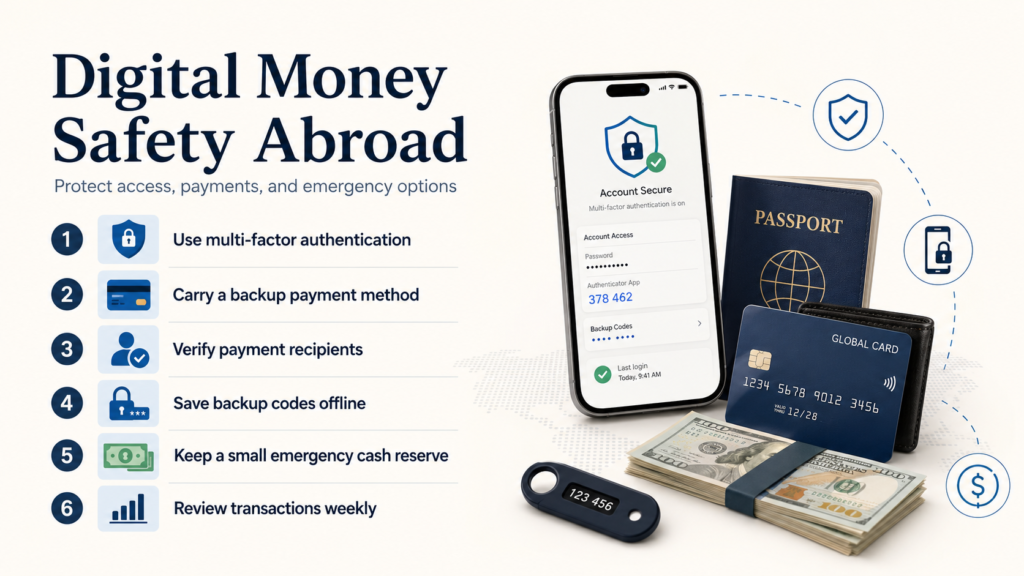
The Federal Trade Commission notes that mobile payment apps are convenient but payments sent to scammers can be difficult to recover. Verify the recipient before sending money and confirm unexpected requests through another channel.
Use multi-factor authentication or a strong PIN on banking, email, university, cloud, and payment accounts.
Carry at least one backup payment method separately from the main wallet. Keep a small emergency cash reserve where appropriate.
Store offline recovery codes, emergency contacts, insurer details, university support numbers, and card cancellation information.
Review transactions every week and respond quickly to unfamiliar charges.
Budget Social Life Without Missing the Experience
A study abroad budget should include friendships, cultural experiences, local food, museums, student events, and travel. Removing every enjoyable expense can lead to isolation or rebound spending.
Choose a weekly social allowance and a separate travel sinking fund.
Use free university events, student discounts, local festivals, shared meals, walking tours, public spaces, and one planned paid experience instead of frequent unplanned purchases.
Decide which experiences matter most before social pressure decides for you.
Plan for Scholarships, Aid, and Family Support
Confirm the exact payment dates, currencies, conditions, and renewal requirements for scholarships, stipends, loans, and family transfers.
Ask whether the university offers emergency grants, meal support, hardship assistance, technology loans, travel bursaries, or temporary accommodation support.
Do not assume that part-time work is allowed or easy to obtain. Employment rules depend on the visa, destination, programme, and current regulations. Check official immigration and university guidance.
Keep a funding calendar so tuition deadlines, deposit deadlines, stipend dates, and rent payments do not collide.
Build an Emergency Buffer for Study Abroad
An emergency buffer can cover delayed housing, a missed flight, urgent transport, a device failure, medicine, temporary accommodation, or a delayed stipend.
Keep the buffer separate from weekend travel and shopping money.
A practical first target is enough for several days of essential living and an urgent journey. Build toward a larger reserve when possible.
Know how family or trusted contacts could send emergency money, but do not rely on an untested transfer method.
Your 15-Minute Weekly Digital Money Review
- Check local and home-country bank balances.
- Review pending card and payment-app transactions.
- Update rent, food, transport, health, education, digital, and social categories.
- Check upcoming subscription renewals and data-plan expiry.
- Review the exchange rate only when a transfer or large payment is approaching.
- Move unused money to the emergency buffer or travel fund.
- Plan the next seven days of classes, food, transport, events, and travel.
30-Day Arrival Budget Plan
Week 1: protect cash, confirm housing, activate communication, learn transport, buy only essential setup items, and record every expense.
Week 2: compare grocery shops, campus food, public transport, student discounts, local banking options, and phone plans.
Week 3: cancel temporary services, review convenience spending, and set realistic weekly limits.
Week 4: compare actual spending with the original budget, adjust family transfer timing, and automate the next month’s savings or sinking funds.
Common Gen Z Study Abroad Budget Mistakes
- Planning tuition and rent but ignoring arrival costs.
- Keeping every home-country subscription active.
- Using food delivery and rides as default habits.
- Depending on one phone, one card, or one payment app.
- Treating scholarships or part-time work as guaranteed before confirmation.
- Mixing emergency money with weekend travel money.
- Budgeting in the home currency instead of the destination currency.
- Ignoring exchange-rate and transfer fees.
- Spending heavily in the first month before learning local prices.
Build Your Study Abroad Budget
Compare the plan with the Budget Calculator, set targets with the Savings Goal Calculator, and track the month in the Budget Dashboard.
Related Moniply Guides
- Travel Budget Guide
- Monthly Budget Checklist
- How to Track Expenses
- Emergency Fund Guide
- Free Money Tools
- Moniply App
Frequently Asked Questions
How much money should I budget for studying abroad?
Add tuition and institutional fees, one-time arrival costs, monthly living costs, digital lifestyle costs, insurance, travel, and an emergency buffer. The amount depends heavily on the country, city, housing and programme.
What digital costs should Gen Z students include?
Include phone or eSIM data, home-number access, cloud storage, streaming, music, gaming, software, AI tools, delivery apps, ride-hailing, device insurance, repairs, chargers and accessories.
Should I keep my home-country subscriptions?
Review each service before departure. Pause anything unavailable, duplicated by the university, or unnecessary during the study period.
Should I budget in my home currency or destination currency?
Use the destination currency for daily budgeting. Use the home currency for total funding, transfers and family reporting.
How can I avoid foreign transaction and ATM fees?
Compare the full fee structure of your bank, card and transfer options before departure. Consider transaction fees, ATM charges, exchange-rate margins and receiving fees.
How much emergency money should a student keep abroad?
Begin with enough for several days of essential housing, food, transport, medicine and communication. Build a larger buffer when possible.
Can I depend on part-time work while studying abroad?
Do not include employment income until you confirm the legal work rules, hours, likely wages, timing and realistic availability through official sources.
How often should I review my study abroad budget?
Review transactions weekly and conduct a full monthly reset. Review sooner after moving, travelling, changing housing or receiving a large payment.
Final Takeaway
A Gen Z study abroad budget should include the life that actually travels with you: devices, data, subscriptions, online habits, payment apps, social plans and weekend exploration. Separate setup costs from monthly costs, build the budget in the destination currency, protect banking access, and review the plan every week.
Disclaimer: This article is for general educational purposes and is not financial, legal, immigration, tax, insurance, cybersecurity or travel-safety advice. Confirm current visa, employment, banking and university requirements with official sources.
Sources and Further Reading
- EducationUSA – Finance Your U.S. Studies
- FTC – Mobile Payment Apps: How To Avoid a Scam
- U.S. Department of State – Students Abroad
- Federal Student Aid – Studying Abroad
Turn this article into a monthly budget
Start with income, fixed costs, flexible spending, and one savings target. Then review your numbers in the dashboard.
Get the Moniply AI Finance Coach app
Moniply is building an Android app that turns budgeting, savings, debt payoff, and money decisions into simple AI-guided next steps.

Author: M.Adil
Finance professional and Moniply founder. Moniply helps everyday people use simple tools, practical guides, and AI-style money coaching to budget, save, and make calmer financial decisions.