
Moving into a first apartment can make a full-time salary feel smaller overnight. Rent is only the beginning: utilities, internet, groceries, commuting, renters insurance, basic furniture, household supplies, deposits, and unexpected repairs all compete for the same paycheck. A simple part-time income plan can create breathing room without turning every evening into a second full-time job. The goal is not endless hustle. It is a controlled, temporary or repeatable income stream that supports rent, builds a small buffer, and protects your main career.
Quick plan: calculate the apartment gap → set one monthly target → choose one sustainable income stream → allocate every payment → review after 30 days.
Start With the Apartment Budget, Not the Side Hustle
Before choosing extra work, calculate the real monthly cost of living alone. List rent, electricity, water, heating or cooling, internet, phone, groceries, transportation, renters insurance, debt minimums, subscriptions, household supplies, and a realistic personal-spending amount.
Include irregular apartment costs as monthly sinking funds. These may include annual insurance, furniture replacement, appliance or electronics repairs, moving supplies, laundry, parking permits, pest control, and travel to visit family.
Use take-home pay rather than gross salary. Compare your dependable monthly income with your complete apartment budget. The difference is your monthly gap. A gap of $250 does not require a business empire; it requires a reliable plan that can net approximately $250 after direct costs and taxes.
The Moniply Budget Calculator can help organize the base budget before any side income is added.
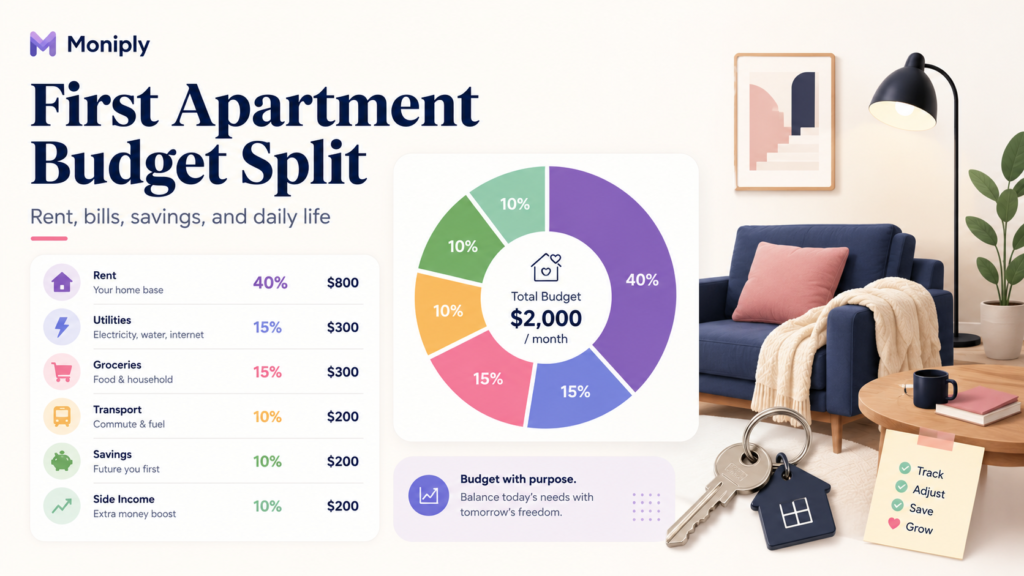
Start your calculation with the Moniply Budget Calculator and compare it with the Monthly Budget Checklist.
Define a Specific Monthly Side-Income Target
Choose a target based on a purpose, not on the maximum amount you could theoretically earn. A clear target prevents side work from expanding into every free hour.
A practical target may cover one bill, create a rent buffer, or finish the apartment setup. For example, $300 per month might be assigned as $150 to a rent buffer, $75 to utilities, $50 to apartment essentials, and $25 to a flexible cushion.
Calculate the number of paid hours required after platform fees, transport, supplies, and tax reserves. If an activity produces $18 net per hour, a $300 target requires about 17 paid hours per month. That may be four hours per week rather than several exhausting shifts.
Set a minimum target, a preferred target, and a stopping point. Once the preferred target is reached, additional work should be optional.
Choose One Sustainable Part-Time Income Stream
Start with one option that matches your skills, schedule, location, equipment, and energy. Testing five side hustles at once creates setup costs and scattered attention.
Freelance services can include writing, bookkeeping, design, presentation formatting, spreadsheet cleanup, social media support, administrative help, video editing, or basic website updates. Existing professional skills usually have lower startup costs than learning an entirely new trade.
Tutoring or coaching can work well for professionals with academic, language, technical, software, interview, or career knowledge. Local or online sessions can be scheduled in fixed weekly blocks.
Pet sitting, dog walking, and house sitting can suit apartment renters who enjoy local work and weekend availability. Confirm building rules, insurance, safety expectations, and whether animals may enter your apartment.
Delivery, retail, hospitality, and event shifts may provide faster cash but can involve travel costs, physical fatigue, demand fluctuations, and late hours. Calculate true earnings after fuel, parking, maintenance, meals, and unpaid waiting time.
Digital services and simple digital products can become repeatable, but they normally require time to build trust and demand. Avoid income claims that promise effortless or guaranteed sales.

Use a Low-Burnout Weekly Schedule
Protect the job that pays your main salary. A side-income plan should fit around sleep, commuting, meal preparation, exercise, relationships, and recovery.
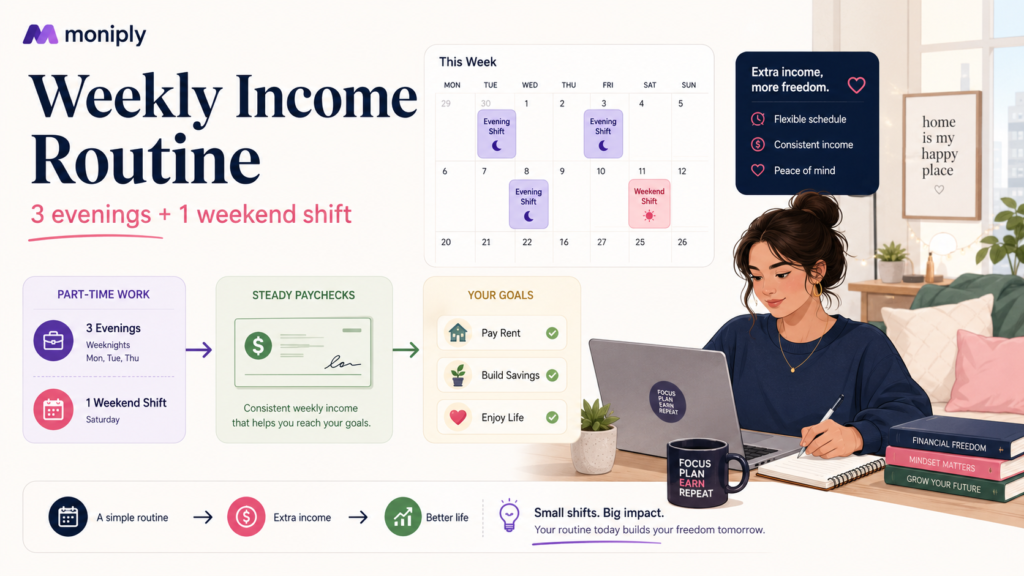
A simple weekly structure might use two focused weeknights and one short weekend block. Keep at least two evenings completely free and avoid accepting work during every high-demand period.
Batch similar tasks together. Complete client messages at one time, schedule tutoring on consistent days, or group local errands into one route. Batching reduces transition time and makes income more predictable.
Set a monthly hour limit. If extra work repeatedly damages performance, health, or attendance at the main job, the plan is costing more than it earns.
Give Every Extra Dollar a Job
Do not allow side income to disappear into random spending. Use a separate account, savings bucket, or clearly labeled budget category.
A useful allocation sequence is: direct work expenses, tax reserve where applicable, rent and essential bills, rent buffer or emergency savings, apartment setup goals, and finally optional lifestyle spending.
If income changes each month, allocate percentages rather than fixed amounts. For example, keep 15% to 25% for taxes and business costs where appropriate, send 40% to the rent buffer, 25% to apartment or emergency savings, and use the remainder for current bills. The right split depends on local tax rules and your costs.
Use the Moniply Savings Goal Calculator to set a target for one month of rent, and the Emergency Fund Calculator to estimate a broader safety net.
Set named goals with the Savings Goal Calculator and estimate a safety net with the Emergency Fund Calculator.
Build a Rent Buffer Before Upgrading the Apartment
A rent buffer is money reserved specifically for housing stability. A first target can be one month of rent plus essential utilities. Later, the buffer can become part of a larger emergency fund.
Prioritize the buffer before decorative upgrades, premium subscriptions, expensive furniture financing, or frequent delivery meals. A comfortable apartment is valuable, but financial stability makes the space feel safer.
Buy apartment items in stages: immediate safety and sleep needs first, daily essentials second, and décor last. Consider second-hand furniture where safe, compare delivery fees, and avoid borrowing for items that can wait.
Track progress visually in the Moniply Budget Dashboard so each side-income payment moves a named goal forward.

Track the buffer in the Moniply Budget Dashboard and review the Emergency Fund Guide for the next stage.
Make Variable Income More Predictable
Side income often fluctuates. Base the apartment budget on the regular salary and treat extra income as support rather than the only way rent gets paid.
Aim for repeat clients, recurring tutoring sessions, scheduled shifts, or service packages instead of constantly searching for one-off work. Predictability reduces unpaid marketing time.
Keep a simple pipeline: confirmed work, proposed work, completed work, invoiced work, and paid work. Do not budget an invoice until the payment arrives.
Review average net earnings over three months. If an activity produces low pay after expenses or causes frequent cancellations, replace it rather than adding more hours.
Use the method in How to Track Expenses to separate earnings, fees and direct costs.
Keep Records and Plan for Taxes
Record every payment, fee, refund, supply purchase, mileage or transport cost, and work-related subscription. Keep receipts and separate personal transfers from customer payments.
Tax rules depend on country, employment status, and the type of work. In the United States, the IRS says gig-economy income must be reported even when it comes from part-time or side work, is paid in cash or another form, or is not shown on an information return. Other countries have different registration, expense, social contribution, and filing rules.
A tax reserve is not extra spending money. Move it aside when income arrives. A qualified tax professional can help determine deductible expenses, estimated payments, and whether additional withholding from the main job is appropriate.
Avoid Side-Hustle and Remote-Job Scams
Urgency around rent can make unrealistic income offers feel attractive. Verify the company, client, payment method, and work before sharing sensitive information.
The U.S. Federal Trade Commission warns that scammers may advertise work-from-home jobs, promise high earnings for little effort, ask for payment for training or starter kits, send fake checks, or recruit people to reship goods. Honest employers do not require workers to pay to get paid.
Avoid any opportunity that asks you to deposit money, buy cryptocurrency, transfer funds for a client, receive and reship packages, or send part of a check back. Search the company name with words such as scam, review, and complaint, and use established payment protections.
A 30-Day Part-Time Income Launch Plan
Week 1 – Calculate the monthly apartment gap, choose one income target, list available hours, and select one realistic service or shift type.
Week 2 – Prepare a simple offer, update a profile or résumé, contact trusted networks, and apply only through verified sources.
Week 3 – Complete the first paid work, track all costs and time, and transfer the payment according to the allocation plan.
Week 4 – Review hourly earnings, energy impact, payment reliability, taxes, and progress toward the rent buffer. Continue, adjust, or replace the activity based on evidence.
Sample Monthly Plan
Assume a young professional earns $3,200 in monthly take-home pay and has a $3,350 apartment-based budget. The initial monthly gap is $150, while the preferred goal is an additional $400 to build stability.
A sample part-time plan could produce $100 from one weekly tutoring session, $180 from two freelance tasks, and $120 from one weekend shift. After reserving $80 for taxes and direct costs, $320 remains.
That $320 could send $150 to the current budget gap, $100 to the rent buffer, $50 to apartment setup, and $20 to guilt-free spending. Once the rent buffer is complete, the same income can support emergency savings, debt payoff, or reduced working hours.
This example is illustrative. Use local wages, taxes, rent, and living costs when creating your own plan.
Monthly Review Questions
- Did the activity meet the minimum income target?
- What was the net hourly rate after all costs?
- Did the work interfere with the main job, sleep, or health?
- Was payment reliable and on time?
- How much moved to the rent buffer or emergency fund?
- Can the process be simplified, repeated, raised in price, or replaced?
- Is the side income still solving the original apartment goal?
When to Reduce or Stop the Side Work
Side income is a tool, not a permanent requirement. Reduce hours when the rent buffer is funded, the main salary rises, a high-cost debt is repaid, or the apartment budget becomes stable.
Stop or change the plan if it creates unsafe working conditions, unpaid labor, repeated late payments, tax problems, main-job performance issues, or ongoing exhaustion.
A successful plan may end with fewer hours, higher-value work, or no side work at all. The goal is financial breathing room, not a life with no free time.
Build Your First-Apartment Income Plan
Start with the Budget Calculator, set your rent-buffer target with the Savings Goal Calculator, and track progress in the Budget Dashboard.
Related Moniply Guides and Tools
- Budget Calculator
- Savings Goal Calculator
- Emergency Fund Calculator
- Debt Payoff Calculator
- Budget Dashboard
- How to Track Expenses
- Monthly Budget Checklist
- 50/30/20 Budget Rule
- Emergency Fund Guide
- Debt Payoff Strategies
- Moniply App
Frequently Asked Questions
How much side income should I earn before renting my first apartment?
Calculate the full apartment budget and compare it with reliable take-home salary. Target the actual monthly gap plus a modest amount for a rent buffer rather than choosing an arbitrary income number.
Should part-time income be used to qualify for an apartment?
Landlords and lenders may have specific documentation and income-history requirements. Do not assume new or irregular side income will be accepted. Confirm local rules and the property manager’s documentation requirements.
What is the best part-time work for a full-time professional?
The best option uses an existing skill, has low setup costs, fits fixed time blocks, and produces a reasonable net hourly rate. Freelancing, tutoring, local services, or scheduled weekend shifts may work depending on the person.
How many hours should I work on a side hustle?
Start with a monthly income target and calculate the hours needed. Many people can test the plan with two short weeknights and one weekend block while protecting sleep and main-job performance.
Should I use side income for rent every month?
It is safer when the main salary can cover the core lease obligation. Use side income to close a temporary gap, create a rent buffer, fund setup costs, or speed up savings rather than depending on unpredictable work indefinitely.
Do I have to pay tax on part-time or freelance income?
Tax treatment depends on the country and work arrangement. In the United States, the IRS says gig income is taxable even when it is part-time, paid in cash, or not reported on an information return. Check current local rules or consult a qualified professional.
How can I avoid fake remote jobs and side-hustle scams?
Verify the company and recruiter, never pay to get paid, avoid fake-check arrangements, do not receive or forward money or packages, and be cautious of guaranteed high earnings for little work.
What should I buy first for a new apartment?
Prioritize safety, sleep, food preparation, cleaning, lighting, and essential work needs. Delay décor, upgrades, and financed furniture until the rent buffer and core budget are stable.
Final Takeaway
The strongest plan is small, specific and sustainable. Use extra income to build stability, then reduce the hours when the goal is complete.
Disclaimer: This article provides general educational information and is not personalized tax, legal, employment, insurance, tenancy, investment or financial advice. Rules and costs vary by country, city, employer, platform and lease. Verify current requirements with qualified local professionals and official sources.
Sources and Further Reading
- IRS Gig Economy Tax Center
- FTC Job Scams Consumer Advice
- U.S. Bureau of Labor Statistics – Multiple Jobholders
Turn this guide into a practical money plan
Use the relevant Moniply tool, review your numbers, then join the app waitlist for AI-guided money habits.
Get the Moniply AI Finance Coach app
Moniply is building an Android app that turns budgeting, savings, debt payoff, and money decisions into simple AI-guided next steps.

Author: M.Adil
Finance professional and Moniply founder. Moniply helps everyday people use simple tools, practical guides, and AI-style money coaching to budget, save, and make calmer financial decisions.