
A monthly income budget for teachers paid monthly has one main job: make one paycheck last through bills, classroom needs, groceries, transport, savings, debt payments, and the small personal costs that appear between school days. Teachers often face a unique mix of fixed pay, school-year timing, classroom spending, reimbursement delays, professional dues, seasonal costs, and possible summer income gaps. The budget should be simple enough to repeat every payday and flexible enough to survive a busy teaching month.
Why Teachers Paid Monthly Need a Different Budget
Monthly pay can feel simple because money arrives once, but it also creates a longer stretch between paydays. If the first week is not planned carefully, the final week can become stressful.
Teachers also face work-related costs that many other salaried workers do not see as often: classroom supplies, printing, books, professional memberships, certification fees, school-event contributions, extra fuel, and seasonal back-to-school costs.
The goal is not to make the budget strict or joyless. The goal is to give every major category a clear place so your paycheck does not disappear into urgent decisions.
Start With Net Monthly Income, Not Gross Salary
Begin with the amount that actually reaches your bank account after tax withholding, pension or retirement contributions, insurance, union dues, loan deductions, and other payroll deductions.
If your contract salary is annual but paid monthly, convert it into real monthly take-home pay. Do not build your living budget on a headline salary because deductions can create a very different monthly reality.
Create a small paystub note with three numbers: gross monthly pay, total deductions, and net monthly pay. The net amount is the number your budget should use.
Step 1: Build a Payday Bill Calendar
Write every fixed bill due between this payday and the next payday. Include rent or mortgage, utilities, insurance, phone, internet, transport passes, debt minimums, subscriptions, childcare, union dues if not payroll-deducted, and any school-related commitments.
Sort bills by due date. This shows which money must stay untouched in the account and which categories can be planned weekly.
Teachers paid monthly should avoid treating the full paycheck as spendable cash. A bill calendar protects money that already belongs to upcoming obligations.
Step 2: Use a Simple Teacher Budget Allocation
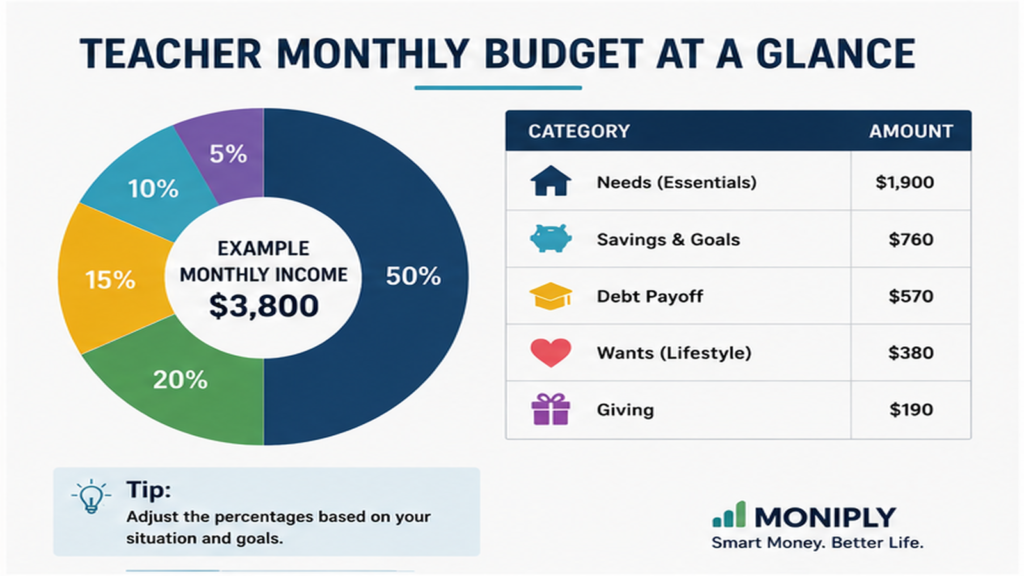
A starting framework can help, but it should not become a rule you follow blindly. One possible teacher budget allocation is: 45% essential bills, 20% food and commute, 10% classroom and professional costs, 15% savings and buffers, and 10% flexible spending.
These percentages are only a planning guide. A teacher in a high-rent city, a parent with childcare costs, or a new teacher with student loans may need different numbers.
Use the Moniply Budget Calculator to test your real income, fixed costs, savings goals, and flexible categories before choosing your final allocation.
Step 3: Create a Classroom Spending Fund
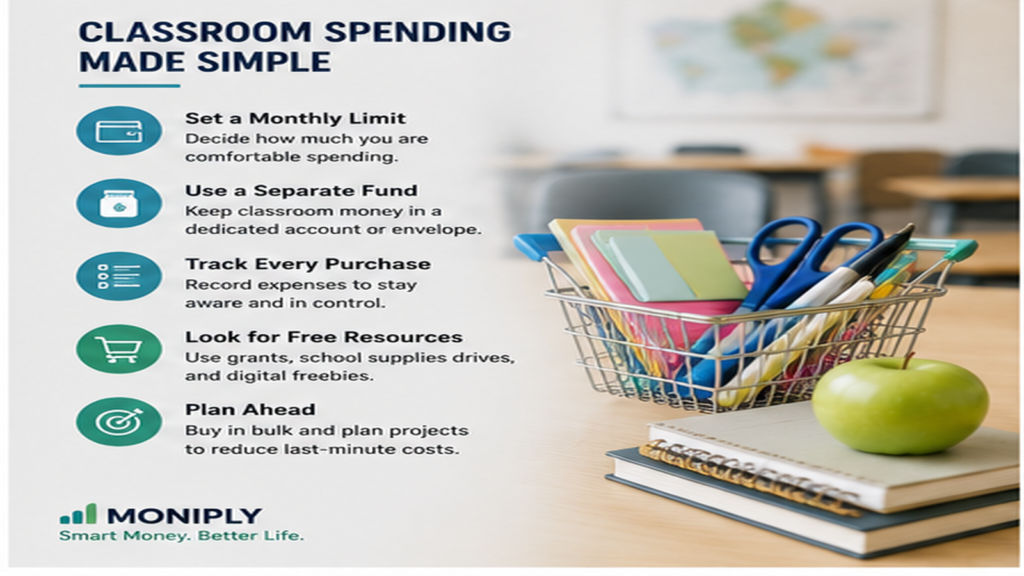
Classroom spending should not hide inside groceries, personal shopping, or miscellaneous expenses. Give it its own category.
This fund can cover supplies, decorations, books, learning materials, printing, prizes, emergency student supplies, software, and small classroom needs. Add a monthly limit, even if the limit is small.
If your school reimburses some expenses, track what you paid, what you submitted, and what has been reimbursed. Keep receipts in one folder or scanning app so the money story stays clear.
Step 4: Plan for Reimbursements and Tax Rules Carefully
Reimbursement timing can create a cash-flow problem. If you spend personal money today and the school reimburses weeks later, your monthly budget still feels the pressure today.
Use a reimbursement tracker with columns for date, item, amount, purpose, receipt saved, submitted date, approval status, and reimbursement date.
For U.S. K-12 educators, the IRS educator expense deduction may apply to eligible teachers, instructors, counselors, principals, and aides who meet specific requirements. The IRS says eligible educators generally must work at least 900 hours during the school year in a school providing elementary or secondary education under state law. Tax rules change and vary by country, so verify current official guidance or speak with a qualified tax professional.
Step 5: Build a Summer Gap and School-Year Timing Buffer
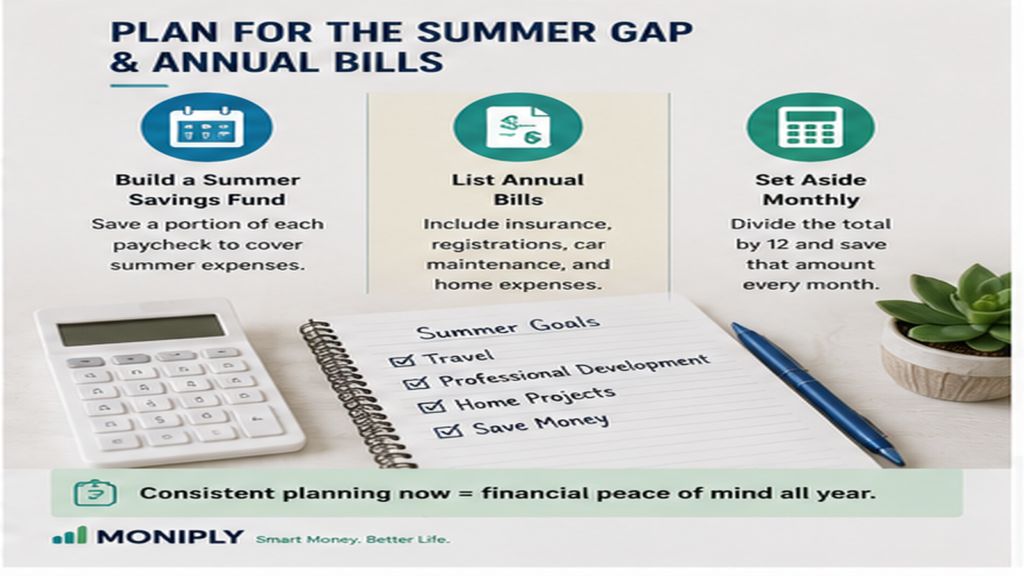
Some teachers are paid over 12 months. Others may be paid over 10 or 11 months or have different contract arrangements. Even when pay is spread across the year, school-year spending can still spike at certain times.
Build a summer or school-break buffer if your income changes during breaks, tutoring slows down, overtime stops, or extra seasonal costs appear.
A simple formula is: expected unpaid or lower-income summer gap divided by the number of months left before summer. Move that amount into a separate savings bucket every payday.
Step 6: Build Annual Bills Into the Monthly Budget
Teachers can have annual or semiannual costs that do not match monthly pay: professional license renewal, union or association fees, continuing education, car registration, insurance premiums, medical costs, holidays, gifts, conferences, and classroom setup.
Turn annual costs into monthly sinking funds. If a license renewal is $240 per year, the budget needs $20 per month. If back-to-school setup usually costs $360, save $30 per month.
This prevents annual bills from pretending to be emergencies.
Step 7: Protect Emergency Savings
An emergency fund is for real surprises, not predictable school-year expenses. Keep it separate from classroom spending, annual bills, and summer savings.
A starter emergency fund can be small at first. The Moniply Emergency Fund Calculator can help estimate a target based on essential monthly expenses.
If your budget is tight, choose a repeatable amount and automate it on payday. Small deposits create a habit and protect you from relying on credit for every surprise.
Step 8: Plan Food, Lunch, and Commute Costs
Teaching days can make convenience spending tempting. Busy mornings, short lunch breaks, after-school meetings, and grading fatigue can turn coffee, delivery, snacks, and fuel into silent budget leaks.
Plan a realistic school-week food routine. You do not need a perfect meal plan. You need a routine that reduces expensive last-minute choices.
For commute costs, estimate fuel, parking, public transit, rideshare, maintenance, and school-event travel. If the commute changes by term or season, update the number.
Step 9: Balance Debt Payoff With Cash Flow
Debt payoff matters, but a paid-monthly teacher budget also needs cash stability. Paying too aggressively at the beginning of the month can create pressure later.
Keep minimum payments current, build a small cash buffer, then add extra debt payments after essentials and immediate savings are protected.
Use the Moniply Debt Payoff Calculator to compare strategies. The debt snowball may help with motivation, while the debt avalanche may reduce interest costs over time.
Step 10: Use a Weekly Review Instead of Daily Guilt
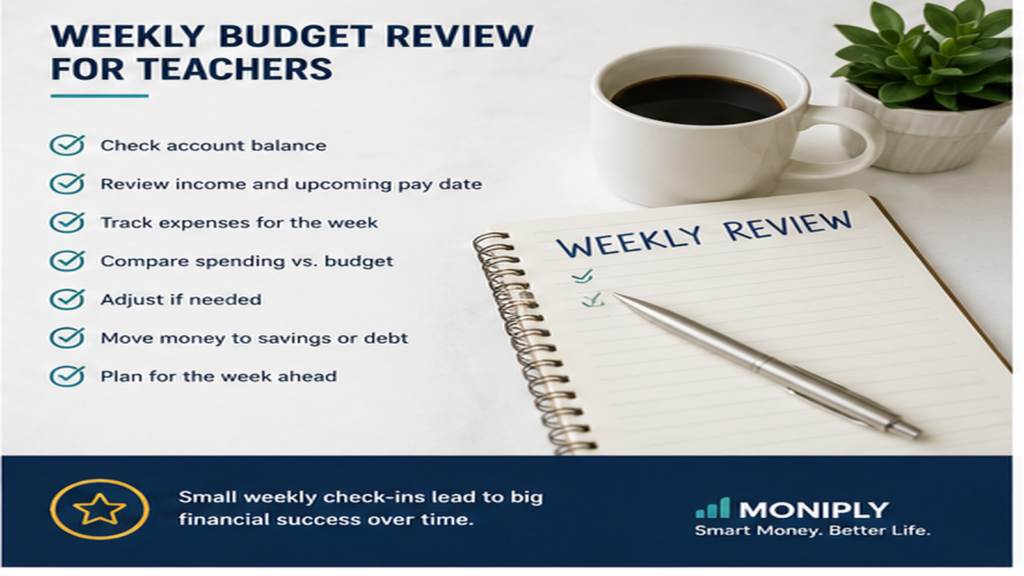
A teacher’s schedule can be too busy for constant budgeting. A weekly review is often more realistic than daily perfection.
Choose one review time, such as Friday after school or Sunday evening. Check remaining bill money, food and commute spending, classroom purchases, upcoming school costs, and savings transfers.
The goal is to catch problems early, not criticize yourself for every small purchase.
A Sample Monthly Teacher Budget
- Example net monthly income: $3,900.
- Essential bills: $1,755.
- Food and commute: $780.
- Classroom and professional costs: $390.
- Savings and buffers: $585.
- Flexible spending: $390.
- This is only an example. Your rent, family situation, debt, city, transportation, and contract structure may require different numbers.
Teacher Budget Buckets to Create
- Bills bucket: fixed expenses and required payments.
- Food and commute bucket: groceries, lunch, fuel, transit, parking and school travel.
- Classroom fund: supplies, printing, decor, learning materials and reimbursements.
- Emergency fund: real surprises and urgent needs.
- Summer gap fund: school-break or lower-income months.
- Annual bills fund: renewals, insurance, holidays, conferences and back-to-school setup.
- Professional growth fund: courses, books, certifications and career development.
- Flexible life fund: guilt-free personal spending that fits the plan.
How Moniply Can Help Teachers Budget Monthly Pay
- Use the Moniply Budget Calculator to map your monthly paycheck into planned categories.
- Use the Savings Goal Calculator to create summer, emergency, classroom and annual-bill buckets.
- Use the Emergency Fund Calculator to estimate a safety-net target.
- Use the Debt Payoff Calculator to compare repayment strategies if debt is part of your plan.
- Use the Budget Dashboard to track spending categories through the month.
Common Monthly Budget Mistakes Teachers Should Avoid
- Budgeting from gross salary instead of take-home pay.
- Forgetting classroom costs until the credit card bill arrives.
- Treating reimbursable school spending as free spending.
- Ignoring summer or school-break income gaps.
- Not spreading annual costs across the year.
- Overpaying debt before food, bills and cash-flow stability are protected.
- Keeping emergency savings, classroom money and annual bills in one confusing account.
- Checking the budget only after the month has gone wrong.
Final Takeaway
Teachers paid monthly need a budget that respects both the paycheck cycle and the school-year cycle. Start with net pay, schedule bills first, separate classroom spending, build savings buffers, plan summer and annual costs, and review weekly. A calm budget gives you more energy for teaching, family, rest, and your own financial goals.
Build Your Teacher Budget in Moniply
Start with the Budget Calculator, build savings buckets with the Savings Goal Calculator, estimate your safety net with the Emergency Fund Calculator, compare repayment strategies with the Debt Payoff Calculator, and track the month in the Budget Dashboard.
Related Moniply Guides
- Monthly Budget Checklist
- How to Start a Savings Plan
- How to Track Expenses
- Emergency Fund Guide
- Debt Payoff Strategies
- Free Money Tools
- Moniply App
Frequently Asked Questions
How should teachers budget if they are paid once a month?
Start with net monthly pay, schedule fixed bills by due date, separate classroom spending, move savings on payday, and review the budget weekly.
What budget categories should teachers use?
Useful teacher categories include fixed bills, food, commute, classroom supplies, professional dues, emergency savings, summer buffer, annual bills, debt payments, and flexible spending.
How can teachers stop classroom supplies from hurting their budget?
Create a monthly classroom spending cap, track receipts, submit reimbursements quickly, and separate school spending from personal spending.
Should teachers save for summer?
Teachers should review their pay schedule. If income drops or expenses rise during breaks, a summer gap fund can prevent stress.
How much should a teacher save each month?
The amount depends on income, bills, debt, dependents, summer pay structure, and emergency needs. Start with a repeatable amount and increase it gradually.
Can teachers deduct classroom expenses?
Tax rules vary. U.S. K-12 educators may qualify for the IRS educator expense deduction if they meet official requirements, but teachers should verify current rules or consult a qualified tax professional.
Is the 50/30/20 rule good for teachers?
It can be a starting point, but teachers may need extra categories for classroom costs, summer gaps, professional dues, and annual school-year expenses.
What is the best Moniply tool for this article?
Start with the Budget Calculator, then use the Savings Goal Calculator, Emergency Fund Calculator, Debt Payoff Calculator and Budget Dashboard as needed.
Disclaimer: General educational content only. Verify payroll, tax, reimbursement and employment details with official sources or a qualified professional.
Sources and Further Reading
- CFPB – Your Money, Your Goals toolkit
- CFPB – Bill calendar and budget timing guidance
- IRS – Topic No. 458 Educator Expense Deduction
- IRS – Out-of-pocket classroom costs and Educator Expense Deduction
Turn this article into a monthly budget
Start with income, fixed costs, flexible spending, and one savings target. Then review your numbers in the dashboard.
Get the Moniply AI Finance Coach app
Moniply is building an Android app that turns budgeting, savings, debt payoff, and money decisions into simple AI-guided next steps.

Author: M.Adil
Finance professional and Moniply founder. Moniply helps everyday people use simple tools, practical guides, and AI-style money coaching to budget, save, and make calmer financial decisions.