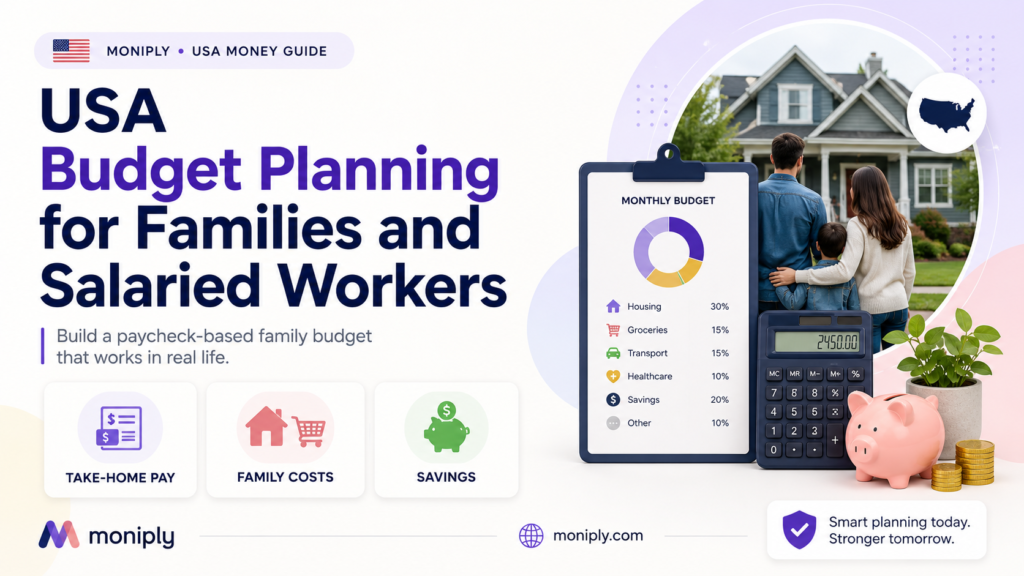
A family budget in the United States has to do more than divide income into neat percentages. It must absorb payroll deductions, housing costs, groceries, transportation, healthcare, childcare, school expenses, insurance, debt payments, and the irregular costs that appear throughout the year. For salaried workers, the strongest plan begins with the money that actually reaches the bank account and gives each paycheck a job before the month becomes busy.
Why USA Families Need a Paycheck-Based Budget
A salary may look stable on paper, but household cash flow can still feel unpredictable. Health deductions, taxes, retirement contributions, benefit changes, bonus timing, school costs, car repairs, medical copays, and seasonal spending can make two months with the same salary feel completely different.
The U.S. Bureau of Labor Statistics Consumer Expenditure Survey tracks household income and spending across a wide range of categories. Its 2024 data showed that housing and transportation together accounted for more than half of average household spending, which helps explain why families can feel squeezed even when income is regular.
A useful budget does not copy national averages. It uses your actual take-home pay, local housing costs, family size, insurance coverage, work commute, debt obligations, and priorities.
Step 1: Start With Net Take-Home Pay
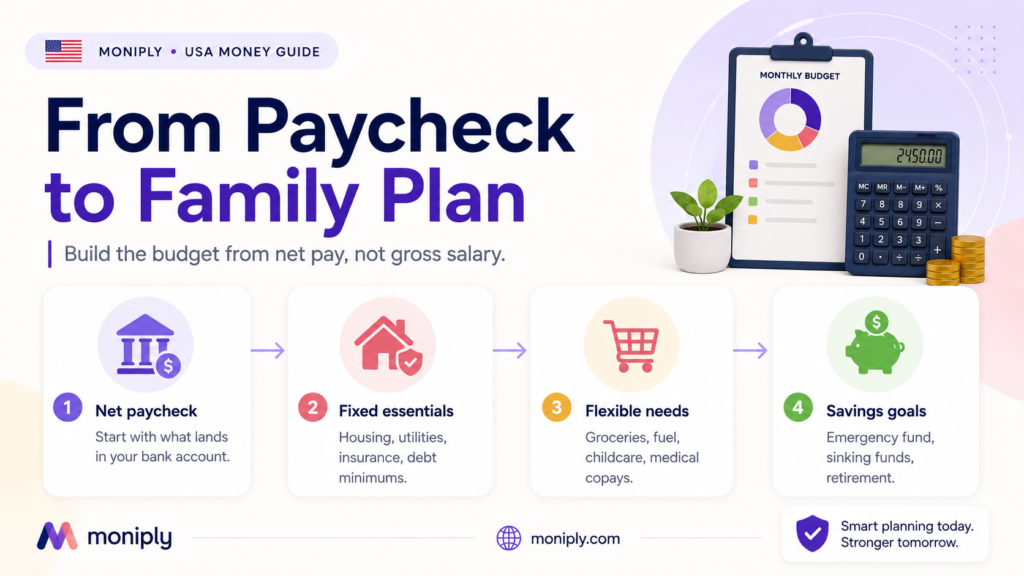
Build the monthly plan from deposits that actually arrive in your checking account, not gross annual salary. Gross salary does not reflect federal withholding, state or local taxes, Social Security and Medicare withholding, health insurance premiums, retirement contributions, flexible spending accounts, garnishments, or other payroll deductions.
Gather the most recent paystubs for each salaried adult. Record regular net pay, predictable child support or benefits, and any reliable side income. Treat bonuses, overtime, commissions, and tax refunds as variable money unless they are truly guaranteed.
If your withholding no longer matches your household situation, the IRS Tax Withholding Estimator can help W-2 workers estimate whether too much or too little federal income tax is being withheld. The IRS notes that the tool uses recent paystubs and may help reduce the risk of a tax-time balance or excessive withholding.
Step 2: Convert Pay Frequency Into a Monthly Number
Weekly workers usually receive 52 paychecks per year, biweekly workers 26, semimonthly workers 24, and monthly workers 12. A quick monthly estimate is annual net pay divided by 12, but the actual calendar matters.
Biweekly workers receive two three-paycheck months in most years. Those extra checks are powerful for emergency savings, debt reduction, annual expenses, or family goals. Avoid building recurring bills that require the third paycheck to survive.
For a two-income household, note whether paydays fall together or alternate. Alternating paydays can support a paycheck budget in which each deposit funds specific bills and categories.
Step 3: Fund the Non-Negotiable Family Essentials
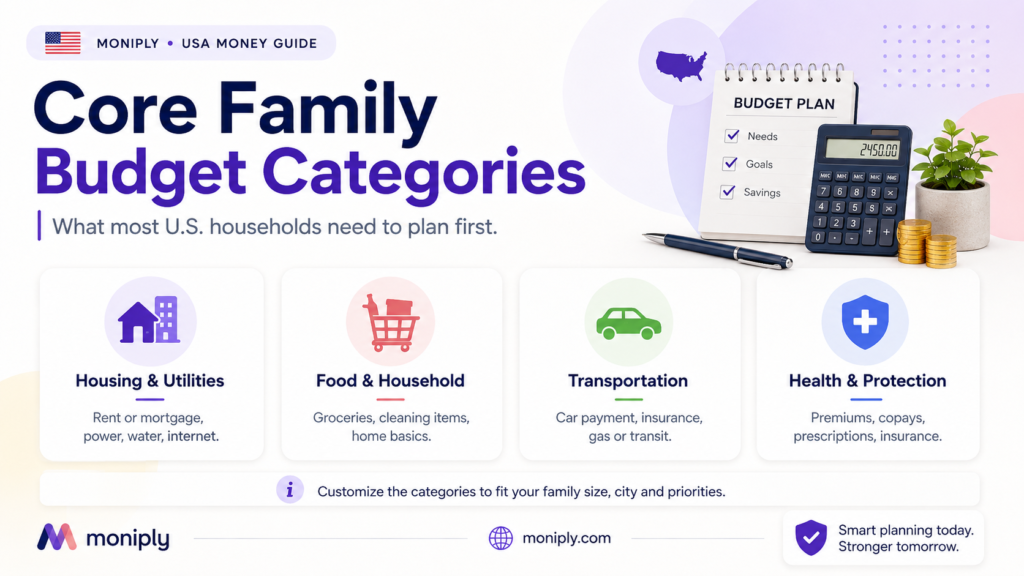
Begin with housing and basic utilities: rent or mortgage, property taxes or homeowners association dues when applicable, electricity, gas, water, trash, internet, and a basic phone plan.
Add transportation costs: car payments, auto insurance, fuel, registration, tolls, parking, public transit, and realistic maintenance. Transportation should include the cost of keeping the vehicle usable, not only the monthly payment.
Add groceries and household supplies, healthcare premiums and copays, prescriptions, childcare, school meals or supplies, and minimum debt payments.
Separate true essentials from convenient upgrades. The point is not to eliminate comfort; it is to know which costs must be protected first if income drops or an emergency occurs.
Step 4: Use Flexible Categories With Weekly Limits
Flexible categories are easier to manage when the monthly amount is divided into weekly targets. Groceries, gas, dining out, personal spending, household supplies, children’s activities, and entertainment often become difficult because the entire monthly amount is available at once.
A family with a $1,000 monthly grocery and household budget might begin with a weekly target of about $230 and retain the remainder for a longer fifth week or bulk purchase. The number should reflect your household, location, dietary needs, and store access.
The USDA publishes monthly food plans at several cost levels. These plans can provide a reference point, but they are national estimates and do not replace a local, family-specific grocery budget.
Step 5: Pay Yourself First Through Payroll and Automation
Savings should be treated as a planned transfer rather than whatever remains after spending. For salaried workers, automation can happen through workplace retirement contributions, split direct deposit, scheduled bank transfers, or separate savings accounts.
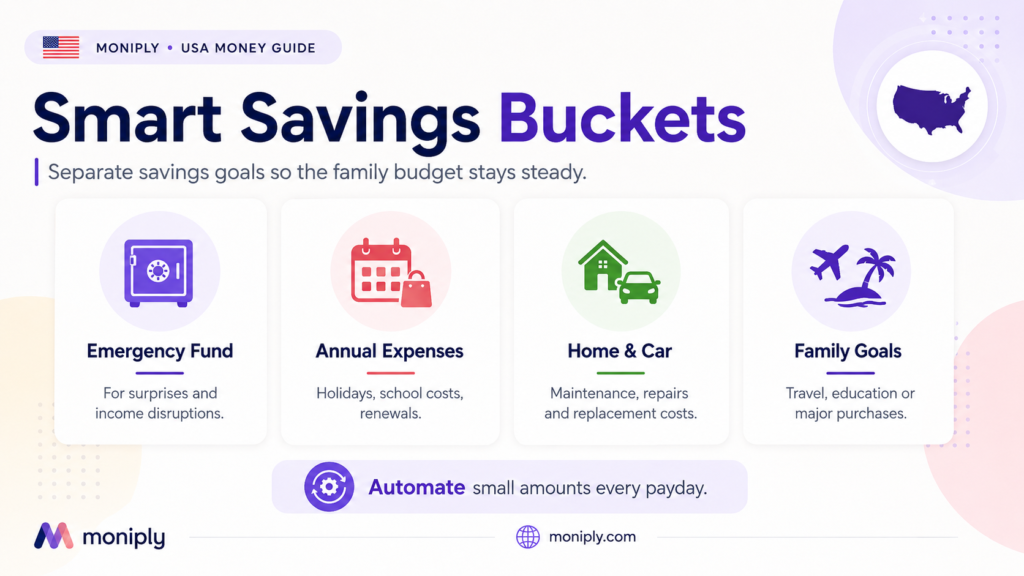
Use four savings buckets: an emergency fund, annual or irregular expenses, home and vehicle maintenance, and family goals.
If money is tight, begin with a small automatic amount and increase it after raises, debt payoff, benefit changes, or major expenses end. Consistency is more useful than setting an unrealistic target that is repeatedly cancelled.
Step 6: Create Sinking Funds for Irregular Costs
A sinking fund is money saved gradually for a known future expense. Unlike an emergency fund, the cost is expected even if the exact amount or date is uncertain.
Common family sinking funds include car repairs, home maintenance, school expenses, holidays, birthdays, annual insurance premiums, medical deductibles, travel, clothing, professional fees, pet care, and technology replacement.
Review the past twelve months of statements and calendars. List costs that surprised you but were not truly emergencies. Divide the annual estimate by twelve and add the amount to the monthly plan.
Step 7: Budget for Healthcare and Insurance Realistically
Do not stop at the payroll premium. Include deductibles, copays, coinsurance, prescriptions, dental care, vision costs, therapy, medical equipment, and travel or parking for appointments.
Review employer benefits during open enrollment and after major life events. A lower premium is not automatically cheaper if the deductible and out-of-pocket exposure are much higher.
Life insurance, disability coverage, renters or homeowners insurance, and auto liability limits are part of protecting the budget. Insurance decisions are personal and may require a qualified professional.
Step 8: Plan Debt Payments Without Starving the Budget
Pay every required minimum on time. Then choose a focused extra-payment strategy that does not leave the household without cash for food, transportation, medical needs, or minor emergencies.
A small emergency buffer can reduce the chance that a car repair or medical bill goes straight back onto a credit card.
When debt is expensive, use bonuses, tax refunds, three-paycheck months, or reduced expenses for targeted extra payments rather than permanently overloading the monthly plan.
Step 9: Build a Budget That Works for Two Salaries
Couples can combine all money, keep accounts separate, or use a hybrid system. The structure matters less than transparency, agreed responsibilities, and shared visibility.
Choose how bills will be divided: equally, proportionally by take-home pay, or by assigned categories. Write the decision down so it does not depend on memory.
Schedule a short weekly review and a deeper monthly meeting. Discuss upcoming costs, not only past mistakes. Avoid blaming language and focus on the plan.
Step 10: Use a Monthly Family Budget Formula as a Starting Point
A percentage method can provide structure, but U.S. family costs vary too widely for one ratio to fit everyone. High-cost housing, childcare, medical needs, student debt, or a long commute may consume a larger share of income.
A flexible starting framework is 60% to 70% for core living costs and minimum debt payments, 10% to 20% for savings and long-term goals, and the remainder for flexible spending, giving, and extra debt reduction.
If essentials exceed the target, do not force the numbers. Identify the largest categories, compare options, improve income where possible, and protect a small savings line.
Sample Monthly Budget for a Salaried Family
Consider a household with $6,500 in monthly take-home pay. A sample plan might allocate $2,250 to housing and utilities, $1,000 to groceries and household supplies, $850 to transportation, $700 to childcare or education, $450 to healthcare and insurance beyond payroll deductions, $400 to debt minimums, $500 to savings and sinking funds, and $350 to personal, entertainment, and miscellaneous spending.
This is only an illustration. A family without childcare may redirect money to retirement, debt, housing, or savings. A family in a high-cost city may need a larger housing category and a smaller vehicle budget.
The best budget is not the one that looks balanced in an example. It is the one that reflects your real costs and can be followed without constant emergency transfers.
The 15-Minute Weekly Family Budget Review

- Confirm checking, savings, and credit card balances.
- Update recent purchases and pending bills.
- Check groceries, fuel, childcare, healthcare, and personal spending.
- Look ahead seven to fourteen days for school, work, medical, travel, or family events.
- Move unused category money to a sinking fund or savings goal.
- Choose one adjustment for the next week and one topic to discuss at the monthly meeting.
Monthly Reset Checklist
- Compare planned and actual take-home income.
- Review major categories and identify the reason for any difference.
- Refill sinking funds and emergency savings.
- Check debt balances and automatic payments.
- Review subscriptions and annual renewals.
- Update tax withholding after significant changes when appropriate.
- Plan the next month’s school, childcare, medical, travel, and family events.
- Celebrate progress before setting the next improvement.
When the Budget Does Not Balance
If planned expenses exceed take-home pay, start with the largest categories. Housing, transportation, childcare, insurance, debt, and healthcare usually create more impact than cutting a few small purchases.
Contact lenders, insurers, utilities, medical providers, or benefits administrators early when payment difficulty is expected. Review employer assistance, dependent-care benefits, health savings options, commuter benefits, and public programs for which the household may qualify.
Avoid hiding the gap with repeated credit card use. A temporary deficit needs a clear recovery plan with a timeline, specific cuts, income actions, and priority payments.
Build Your USA Family Budget
Start with the Moniply Budget Calculator, estimate your safety net with the Emergency Fund Calculator, and organize the month in the Budget Dashboard.
Related Moniply Guides
- 50/30/20 Budget Rule
- Monthly Budget Checklist
- Emergency Fund Guide
- Debt Payoff Strategies
- Free Money Tools
- Moniply App
Frequently Asked Questions
What percentage of income should a U.S. family spend on housing?
There is no universal percentage that works in every city or family situation. Use take-home pay, total housing costs, commute costs, debt, childcare, and savings needs to determine affordability.
Should a budget use gross salary or take-home pay?
Use take-home pay for the monthly spending plan because it reflects the money available after payroll deductions. Track gross salary separately for benefits, taxes, and career planning.
How should a biweekly salary be budgeted?
Build recurring expenses around two paychecks per month and assign the two extra annual paychecks to savings, debt, annual costs, or family goals.
How much should a salaried family save each month?
Start with an amount the household can repeat. A common long-term target is 10% to 20% for emergency savings, retirement, and goals, but high-cost essentials may require a gradual approach.
What is the difference between an emergency fund and a sinking fund?
An emergency fund covers unexpected financial shocks. A sinking fund prepares for expected or recurring expenses such as car maintenance, holidays, insurance renewals, or school costs.
How often should a family review its budget?
A short weekly review and a fuller monthly reset work well for many households. Review sooner after income, benefits, housing, childcare, or medical changes.
Should spouses combine bank accounts?
Joint, separate, and hybrid systems can all work. The essential elements are transparency, agreed responsibilities, shared goals, and access to the information needed to manage the household.
Does this article provide tax or investment advice?
No. It is general educational information. Use official IRS guidance and qualified professionals for personal tax, legal, insurance, credit, or investment decisions.
Final Takeaway
A strong family budget begins with take-home pay, protects essentials, automates savings, prepares for irregular costs, and creates a regular review rhythm.
Disclaimer: Educational content only. Not personalized financial, tax, legal, investment, credit, insurance, or benefits advice.
Sources and Further Reading
- U.S. Bureau of Labor Statistics – Consumer Expenditure Surveys
- IRS – Tax Withholding Estimator
- USDA – Cost of Food Monthly Reports
Consumer Financial Protection Bureau – Budgeting resources
Turn this article into a monthly budget
Start with income, fixed costs, flexible spending, and one savings target. Then review your numbers in the dashboard.
Get the Moniply AI Finance Coach app
Moniply is building an Android app that turns budgeting, savings, debt payoff, and money decisions into simple AI-guided next steps.

Author: M.Adil
Finance professional and Moniply founder. Moniply helps everyday people use simple tools, practical guides, and AI-style money coaching to budget, save, and make calmer financial decisions.