A sudden move rarely arrives with a neat timeline. A landlord may end a tenancy, a job transfer may come with little notice, a family or medical crisis may require relocation, or safety concerns may make staying impossible. In those moments, the goal is not to create a perfect moving plan. It is to secure safety, shelter, access to money, and enough flexibility to avoid expensive panic decisions.
Quick answer
Save enough to cover immediate transport, 7–14 nights of temporary housing, new-housing entry costs, two weeks of essentials, any likely income gap, and a 10%–20% contingency. The exact amount depends on your household and destination.
What Is an Emergency Relocation Budget?
An emergency relocation budget is a dedicated cash reserve for moving with little warning. It is different from a normal moving budget because it must cover uncertainty: temporary accommodation, deposits, rushed transport, storage, missed work, replacement essentials, and costs that cannot be predicted in advance.
The Consumer Financial Protection Bureau describes an emergency fund as cash set aside for unplanned expenses or financial shocks. A sudden move fits that definition because even a relatively small disruption can become debt when there is no accessible savings buffer.
Your relocation reserve does not need to equal every possible cost. It needs to buy time, preserve choices, and prevent one urgent expense from forcing you into high-interest debt.
How Much Should You Save Before a Sudden Move?
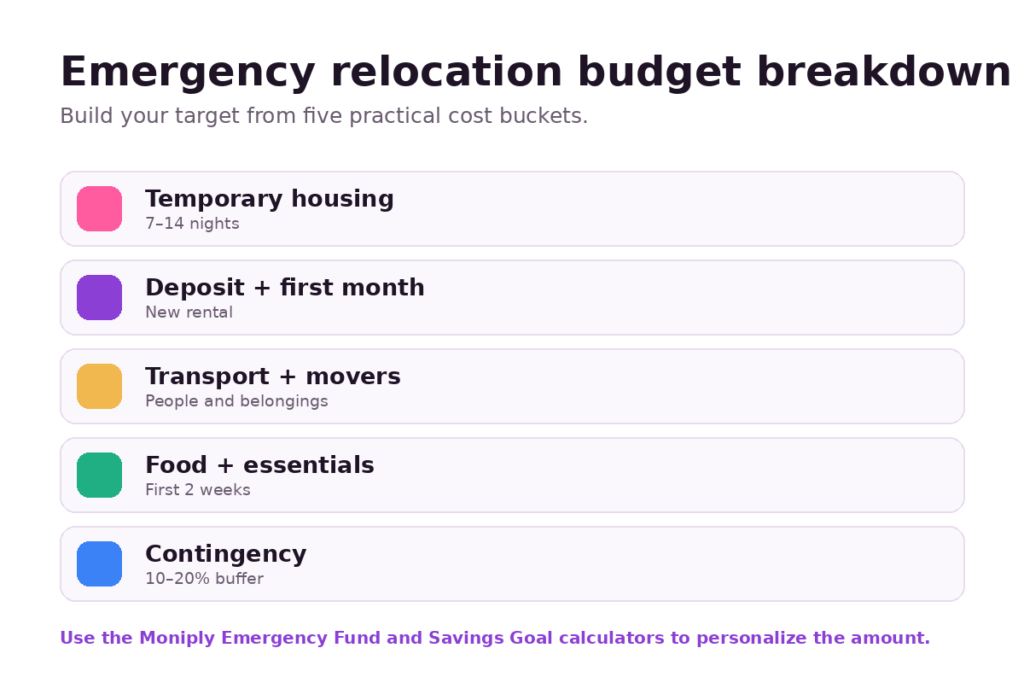
For most households, a practical target is the total of five cost buckets: immediate transport, temporary housing, new-home entry costs, two weeks of essentials, and a contingency buffer.
Use this formula: Emergency relocation target = move cost + temporary housing + deposit and first month + essential setup + income-gap allowance + 10% to 20% contingency.
A single renter moving locally with few belongings may need a smaller reserve. A family, international worker, pet owner, person with mobility needs, or anyone relocating to a high-cost city may need substantially more.
Do not copy a single universal number from the internet. Build the target from your own rent level, household size, transport options, work situation, health needs, and likely destination.
A Practical Three-Level Savings Target
Starter reserve: enough for safe transport, three to seven nights of temporary housing, food, medicine, phone service, and one urgent fee. This is not a full relocation fund, but it can prevent immediate crisis.
Functional reserve: enough for seven to fourteen nights of housing, transport, storage, a rental deposit, first-month housing costs, basic household setup, and a modest contingency.
Strong reserve: the functional reserve plus one month of essential living expenses or expected income loss. This level is especially valuable for families, freelancers, single-income households, newcomers, and people moving between countries.
The Six Costs People Commonly Forget
- Temporary housing extensions. A promised apartment, room, or employer arrangement may be delayed.
- Deposits and overlapping rent. You may need to pay a new deposit before receiving the old one back.
- Storage, baggage, and last-minute transport. Urgent bookings usually cost more and leave less room to compare prices.
- Lost income. Moving days, childcare disruption, onboarding delays, or a gap between jobs can reduce cash flow.
- Replacement essentials. Bedding, chargers, school items, work clothing, kitchen basics, and medicines are often needed before every box arrives.
- Administrative changes. Address updates, vehicle documents, licences, immigration requirements, utilities, and insurance may involve fees or deposits.
Sample Emergency Relocation Budgets
Example 1 — Single renter, local move: transport and boxes, seven nights of temporary housing, deposit and first month, basic food and household setup, plus a 15% buffer.
Example 2 — Family moving to another city: larger transport or moving vehicle, two weeks of accommodation, rental entry costs, school and childcare disruption, food, utilities, and a 20% buffer.
Example 3 — International relocation: flights, extra baggage, visa or document costs, temporary accommodation, local transport, deposits, currency-conversion costs, phone setup, insurance, and at least one month of essential expenses.
These examples are frameworks rather than price quotes. Actual costs vary significantly by country, city, season, household size, and urgency.
What to Do in the First 24 Hours
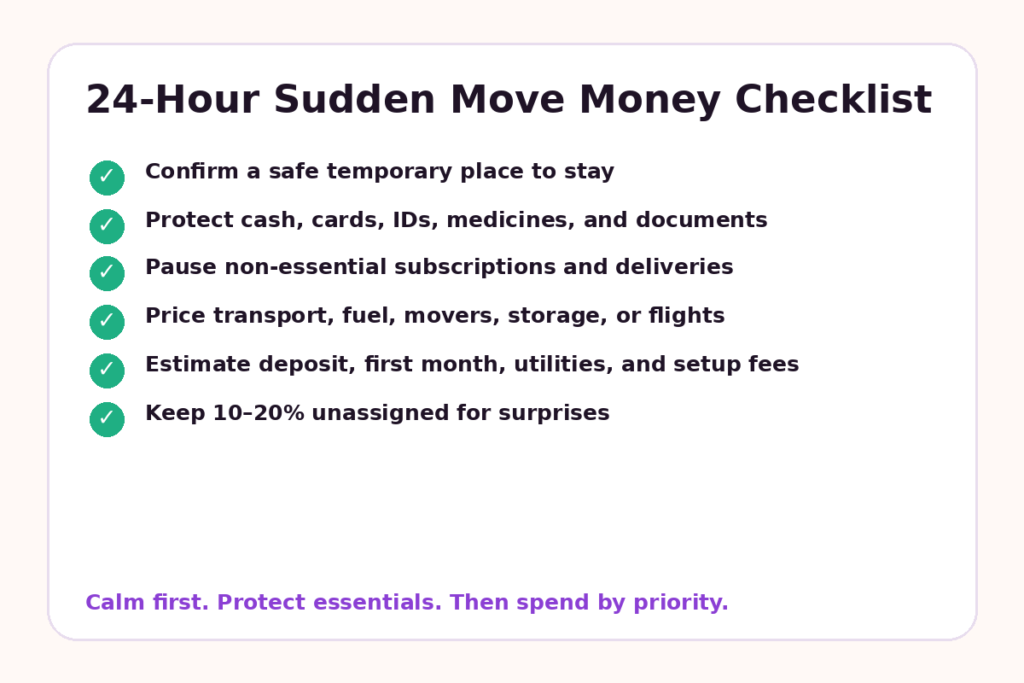
- Confirm a safe place to stay. Separate immediate shelter from your longer-term housing search.
- Protect IDs, bank access, cash, cards, medicines, chargers, employment records, lease documents, and essential contacts.
- Write down your available cash today—not expected money, reimbursements, or deposits that may arrive later.
- Pause discretionary subscriptions, deliveries, and purchases until the move is stable.
- Price the essential move before booking extras: people, medicines, documents, work equipment, and minimum belongings.
- Contact your landlord, employer, insurer, school, utility providers, bank, or local support services where appropriate.
- Keep receipts. Some moving, insurance, employer, tax, or assistance programs may require documentation.
How to Prioritize Spending When Money Is Tight
- Priority 1: personal safety, shelter, medicine, food, communication, and transport.
- Priority 2: income protection—getting to work, maintaining phone and internet access, preserving essential work equipment, and arranging childcare.
- Priority 3: stable housing entry costs and utilities.
- Priority 4: storage and replacement items that cannot wait.
- Priority 5: convenience upgrades, decor, non-essential furniture, and lifestyle purchases.
- When funds are limited, buy time instead of appearances. A simple temporary setup is usually better than using debt to recreate a complete home immediately.
How to Build the Fund Before You Need It
- Open a separate, accessible savings account and label it Emergency Relocation or Move-Now Fund.
- Set a starter target first. A smaller completed goal creates more protection than an ambitious target that never begins.
- Automate a transfer on payday. The CFPB notes that automatic recurring transfers can make savings more consistent, while still requiring balance monitoring to avoid overdraft fees.
- Redirect one-time money—bonuses, refunds, gifts, freelance payments, or sales of unused items—toward the reserve.
- Review the target when rent, family size, job location, health needs, or immigration status changes.
- Use the Moniply Emergency Fund Calculator for your overall safety net, then create a separate moving goal with the Savings Goal Calculator.
Country and Cross-Border Considerations
In the United States, moving may require address updates with the Postal Service and other agencies such as tax, Social Security, immigration, driver licensing, and vehicle-registration services.
For people leaving the United Kingdom, GOV.UK advises notifying relevant offices dealing with tax, benefits, pensions, and other obligations. Similar requirements exist in many countries.
International moves may also involve visas, residence permits, deposits without local credit history, temporary insurance, school records, pet documentation, currency conversion, and delayed access to banking.
Always confirm current requirements with official government, immigration, tax, insurance, and housing sources for the country involved.
When Should You Use Credit?
Credit may be unavoidable when safety is at risk and cash is insufficient. If you must borrow, use the smallest amount needed for the highest-priority costs and compare total fees, not only the monthly payment.
Avoid financing furniture, decor, or replacements before housing and income are stable. If family support is available, agree clearly whether the money is a gift or loan and document repayment expectations.
After the move, create a recovery plan: stabilize monthly cash flow, pay down expensive debt, rebuild the relocation reserve, and update your ongoing budget.
Your Post-Move 30-Day Recovery Plan
- Week 1: secure housing, utilities, medicine, communication, transport, and essential work or school needs.
- Week 2: confirm address changes, insurance, banking, benefits, payroll, school, vehicle, and immigration tasks relevant to your situation.
- Week 3: compare actual spending with your relocation estimate and cancel temporary services you no longer need.
- Week 4: rebuild the emergency fund, create sinking funds for deposits or repairs, and restart normal savings goals.
- Use the Moniply Budget Dashboard to rebuild your monthly plan and track the true cost of the move.
Emergency Relocation Budget Checklist
- Safe temporary housing confirmed
- Cash, cards, IDs, medicine, and documents protected
- Transport and storage priced
- Deposit and first-month housing estimated
- Two weeks of essentials budgeted
- Income gap considered
- 10% to 20% contingency included
- Address, employer, insurance, school, and government updates listed
Use Moniply to Build Your Number
Start with the Emergency Fund Calculator, build a dated target with the Savings Goal Calculator, test monthly affordability with the Budget Calculator, and organize the recovery period in the Budget Dashboard. For future guided tracking, visit the Moniply App page.
Related Moniply Guides
Frequently Asked Questions
Is $1,000 enough for an emergency move?
$1,000 may be a useful starter reserve for transport, a few nights of accommodation, food, and urgent essentials, but it may not cover deposits, rent, movers, or an income gap. Build your target from local housing and transport costs.
Should relocation savings be separate from my emergency fund?
If possible, yes. A separate relocation reserve prevents the move from consuming every dollar available for medical, repair, or income emergencies. If you can maintain only one fund, track how much is available for moving costs.
How much contingency should I add?
A 10% to 20% contingency is a practical starting range. Use a higher buffer when the destination is expensive, the timeline is uncertain, income may stop, or the move involves children, pets, disability needs, or international travel.
What if I must move before I have enough saved?
Prioritize safety, temporary shelter, medicine, communication, and income protection. Ask employers, insurers, landlords, local services, trusted relatives, or community organizations about legitimate assistance. Avoid paying third-party fees for government services that are available directly.
Where should I keep an emergency relocation fund?
Keep it safe, liquid, and accessible. A separate insured bank or credit-union savings account is often suitable. Avoid putting short-term emergency money into volatile investments.
Does this article provide legal or immigration advice?
No. Housing, employment, immigration, tax, benefits, and document requirements vary by location. Use official sources and qualified local professionals for your specific situation.
Final Takeaway
A sudden move is easier to manage when your savings target is based on real cost buckets rather than a vague emergency-fund number. Start with enough to secure safety and time, then build toward housing entry costs, essential living expenses, and a contingency buffer. The purpose of the fund is not to make relocation comfortable—it is to keep an urgent move from becoming a long-term financial crisis.
Important disclaimer
This article is for educational purposes only and is not financial, legal, tax, housing, immigration, insurance, or emergency-services advice. Requirements and costs vary by location and personal circumstances.
Sources and Further Reading
- Consumer Financial Protection Bureau — An essential guide to building an emergency fund
- USA.gov — How to change your address
- GOV.UK — Moving or retiring abroad
Create a savings plan from this guide
Set a realistic monthly target, track progress, and use Moniply tools to stay consistent.
Get the Moniply AI Finance Coach app
Moniply is building an Android app that turns budgeting, savings, debt payoff, and money decisions into simple AI-guided next steps.

Author: M.Adil
Finance professional and Moniply founder. Moniply helps everyday people use simple tools, practical guides, and AI-style money coaching to budget, save, and make calmer financial decisions.